
Do we need all this safety gear?
Depends who you ask. Some kiters treat helmets and vests like mission critical equipment. Others ride in boardshorts and confidence. Most of us sit somewhere in the messy middle, figuring out how much protection we want without feeling wrapped in bubble wrap.
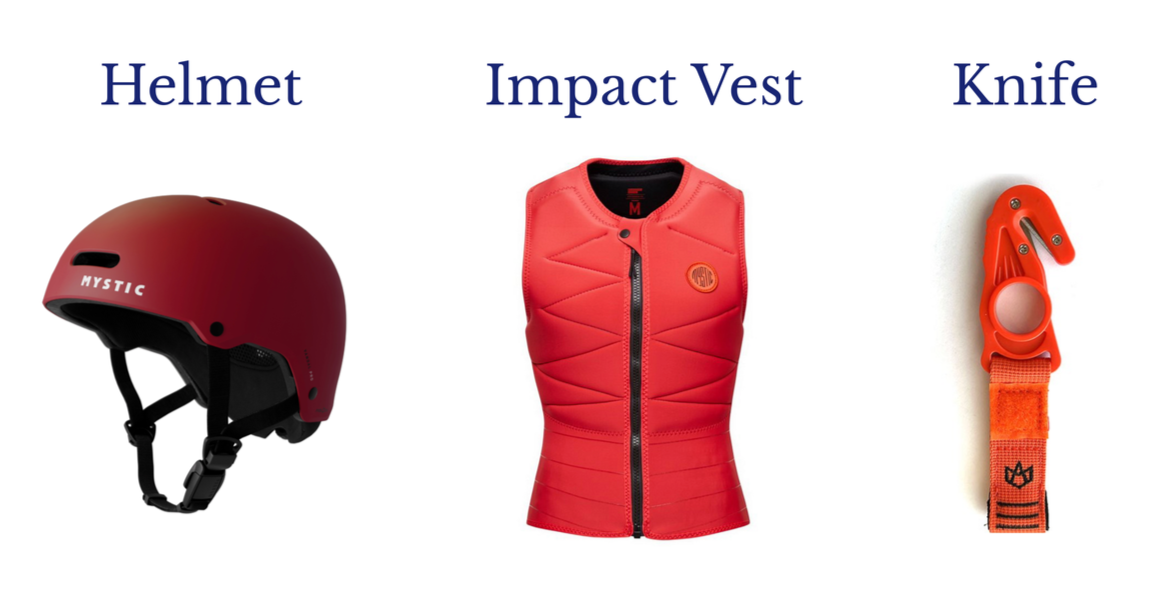
The helmet debate
Helmets have an identity crisis. Some riders treat them as day one essentials. Others think they ruin the aesthetic. But physics is not influenced by fashion. Heads hit boards. Beginners send accidental loops. Advanced riders boost higher and crash harder. And shallow sandbanks do not care who you are.
Here is something a lot of kiters forget. A helmet does not just protect you from your own mistakes. It protects you from everyone else’s. Someone botches a jump and sends their board your way. Someone fails a self launch and their kite lines whip across the beach. Someone loops without looking. A helmet gives you a buffer against other people’s chaos.
There is also an interesting discussion in the community about helmets in high impact crashes. Some riders worry that extra weight on the head can increase rotational force during a violent whiplash. Water helmets are designed to reduce this risk, but the debate exists for a reason. It is not a reason to avoid helmets, only a reminder to choose a light model that fits well.
If you are unsure, think about these real world scenarios:
A mis timed loop sends a board up behind you.
A crowded summer day where riders zigzag unpredictably.
A shallow crash where you clip a rock, sandbar, or sea floor.
Modern helmets are light, comfortable, and barely noticeable once you ride. Even if you do not wear one every session, having one available for busy, gusty, or sketchy days is a smart upgrade.
Impact vest truths
Impact vests have one primary job. Protect your ribs and torso when you send a jump too hard or catch your edge in chop. Flotation is a small bonus, helpful in currents or waves, but not the main point. The real benefit is comfort, confidence, and reducing that stunned feeling after a heavy landing.
A vest helps you ride longer because crashes drain less energy. Beginners often feel more secure during water starts. Freeriders love the extra padding during long sessions. Big air riders and wave riders rely on them for predictable stability during high speed hits.
Common mistakes include:
Buying a wakeboarding vest that does not work under a harness.
Getting one that is too thick so you struggle to breathe fully.
Choosing a vest that is too loose so it rides up all session.
If your local spot has chop, waves, or strong wind, a vest quietly prevents a lot of discomfort you would otherwise call normal.
Knife needed or not
The safety knife sits on your harness, not your bar, and not all brands include one. You often need to buy it separately. Most riders carry one for years without touching it, and that is good. The knife exists for the moments you hope never happen.
This tool is not for trimming loose ends. It is for last resort emergencies where lines become dangerous. When lines wrap under tension, they cut skin and restrict movement instantly. In a worst case scenario, they trap you underwater.
When does a knife actually matter?
A line loops around your arm, ankle, or harness.
Two kites collide and the lines twist into a death loop.
A snag on a rock or buoy pins your system under load.
You might use this knife zero times in your kitesurfing life. But if you ever need it once, it is the most important item on your harness.
The leash situation
Board leashes are not one-size-fits-all. They mean very different things depending on your discipline.
Twin tip leashes are generally unsafe. They turn your board into a fast moving projectile that rebounds toward you. A twin tip attached to your foot or waist can seriously injure you. Most instructors and advanced riders strongly recommend avoiding them. If you lose your board often, train your body dragging instead.
Directional boards are where nuance lives. In big waves, strong currents, offshore winds, or rocky reef conditions, many wave riders use a board leash. Not for convenience, but for safety. A directional board keeps you afloat, helps you escape danger quickly, and prevents long swims in situations where losing the board is genuinely risky.
So, in simple terms:
Twin tip leash: do not.
Foil board leash: absolutely not.
Directional leash: logical for waves, reef spots, and offshore sessions.
Choose based on the environment, not convenience alone.
Spot conditions matter
Safety gear is not about looking tough or cautious. It is about matching your protection to your playground. A flat lagoon with twenty riders requires different habits than a rocky point break with fast waves. Cold water demands more flotation and thicker suits. Shallow sandbars turn helmets into smart investments.
If you want a deeper dive into how climate changes power and risk, check the climate guide which explains how wind density and temperature affect your session.
What pros actually wear
Watch competitions or training videos and you will notice a trend. More and more pros wear helmets. Big air riders, foil racers, freestyle riders, and even wave riders. Impact vests are also becoming standard in high power disciplines because they protect ribs, absorb landings, and reduce fatigue.
Almost no pro uses a board leash unless they are on a directional in waves. The physics are simple. A loose board is safer than a board that can sling back toward your face.
Pros also rely on consistent safety habits:
Checking bridle tension, line condition and kite condition.
Inspecting lines for uneven stretch or weak spots.
Rinsing bars and safeties after every session.
Doing a quick warm up to prevent muscle strain and reaction lag.
Safety is not only gear. It is a routine. Pros reduce risk because they remove all the small failure points before they launch.
What is hype and what is essential
Not all safety gear is equally useful. Some items are worth buying early. Others are optional based on your spot and riding style. A simple but solid foundation looks like this:
Helmet if you want head protection.
Impact vest if you want rib and torso protection.
Knife on your harness.
Wetsuit appropriate for your climate.
You do not need a helmet or vest. They are optional and depend on what feels right for you. But a board leash for a twin tip? That is a hard no. Skip it.
Useful extras include:
Booties for rocky entries.
A waterproof pouch for your phone and hydration backpack for downwinders.
A small first aid kit in your car for post session fixes.
Everything beyond this is preference, not necessity.
Stay salty, not broken
Safety gear does not make you less cool. It makes you more prepared. Choose the items that match your conditions and give you confidence on the water. A helmet or vest will not ruin your riding style, but they might save you from missing weeks of sessions.
And if you still hate the look of helmets, just wait until you see the look of someone explaining their concussion to their boss.
xox Berito