
Understand downloops, kiteloops and heliloops
“Downloops, kiteloops, and heliloops are the same basic move, steering the kite through a circle, but different hands, different timing, and completely different results. A downloop pulls you forward, a kiteloop yanks you horizontally, a heliloop lifts you to cushion a landing. Mixing them up is how riders get hurt.”
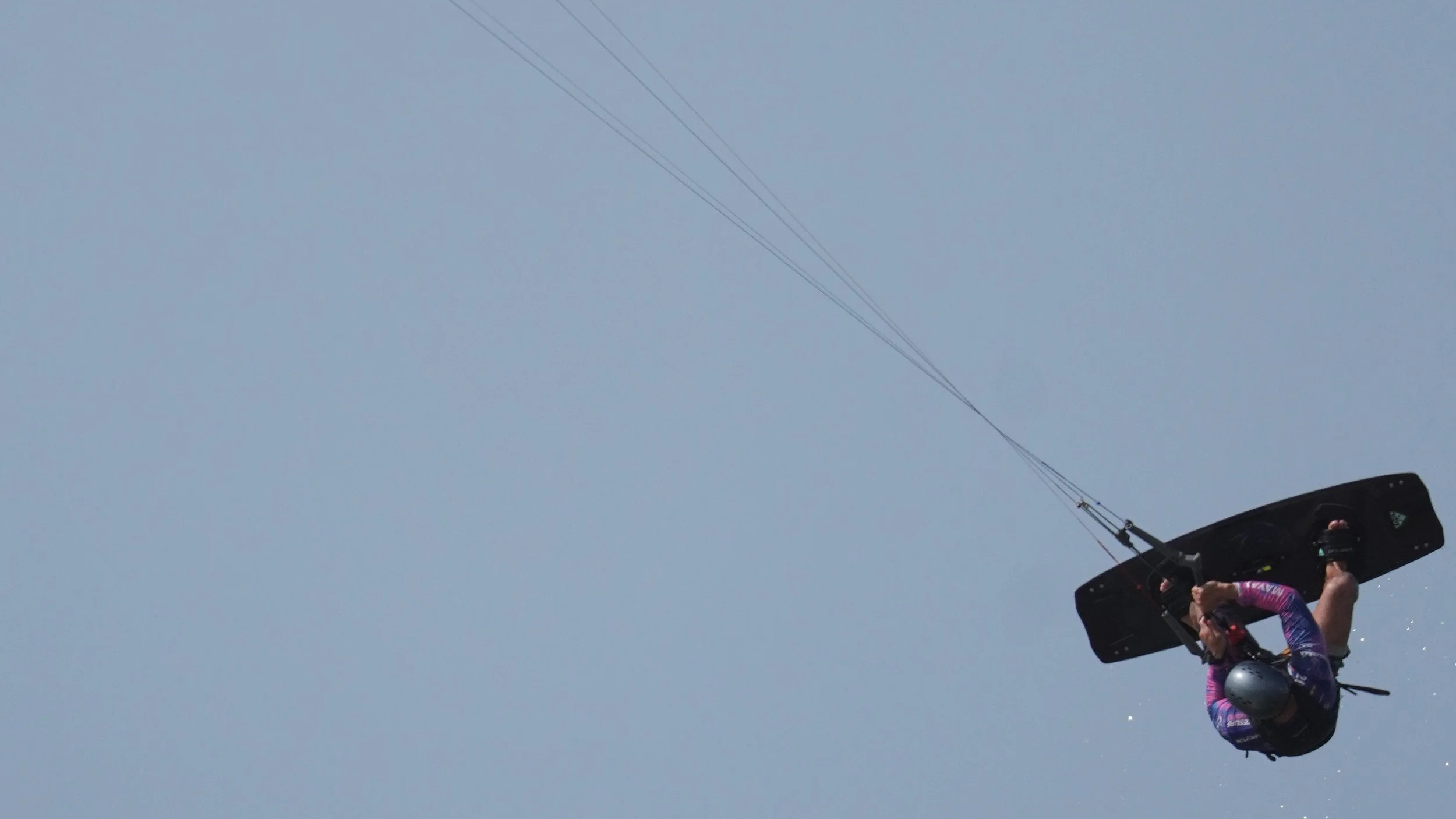
You are riding along on a beautiful sunny day and suddenly someone flies past you, sends their kite in a massive aggressive circle, and shoots horizontally across the sky. It looks absolutely terrifying but also incredibly cool at the same time. You immediately want to do that.
But the word loop is thrown around a lot on the beach. People talk about downloops, kiteloops, heliloops and whateverloops as if they are all the exact same thing. Let me tell you right now, they are absolutely not.
Knowing the mechanical physics behind these different loops will help you apply them to your own sessions safely. Let us unpack the chaotic and wonderful world of looping your kite so you can finally join the club without getting some spectacular bruises or crushing your ego.
Understanding the downloop
A downloop is usually your very first introduction to spinning the kite on purpose instead of by accident. It happens when you pull your front hand incredibly hard, steering the kite into a loop. You complete a full circle in the exact direction you are already traveling or you make it a transition. Downloops are incredibly practical and widely used on the water. They generate a smooth and continuous power pull that keeps you moving forward efficiently. Wave riders use them constantly to keep tension in the lines while carving fast down a wave face. Foilers use them when they do transitions and I like to do them by accident.
Here are the main reasons to use this move:
Smooth transitions: Keep your speed up without sinking.
Wave sessions: Maintain line tension while carving down.
Landing jumps: Pull forward to regain your lost speed.
The technical explanation is delightfully simple. By steering the kite into the loop, the aerodynamic pull goes perfectly in the direction of your momentum. This makes the sudden power delivery feel much less violent than a traditional loop.
The most common mistake beginners make is simply not pulling the bar hard enough. If you steer too slowly or gently, the kite will just crash straight into the water instead of completing the circle. You have to show the kite who is the boss.
Sending the mighty kiteloop
This is the big one. The true kiteloop is the trick that strikes absolute fear into the hearts of average riders everywhere. A true kiteloop happens when you pull your back hand aggressively while high in the air, sending the kite backward into a full circular spin through the power zone. Because the kite loops in front of you, it generates a massive horizontal yank. You get shot forward like a human cannonball. It is an amazing feeling but requires absolute dedication and proper timing.
If you want to survive this trick you must follow these rules:
Total commitment: Never stop pulling the bar once you start.
Back hand: Pull as hard as physically possible.
Body position: Brace your core for the massive pull.
Hesitation is your absolute worst enemy here. If you start a kiteloop and get scared halfway through the rotation, your natural instinct is to let out the bar. This causes the kite to stop turning, which guarantees a spectacular wipeout. To get your mind right for this terrifying step, read my post on training your mind for kitesurfing success to build the mental resilience you absolutely need.
Soft landings with heliloops
When you start jumping seriously high, gravity becomes a very serious problem. Dropping from ten meters up feels exactly like hitting solid concrete if you do not have any forward momentum. This is exactly where the elegant heliloop saves your knees from destruction. A heliloop is a top loop performed right at the apex of your jump or during your downward descent. You pull your front hand or back hand to spin the kite in a tight circle directly above your head near the zenith.
The secret sauce here is all about timing. If you loop early while you are still going up, you are doing a kiteloop and you will get yanked horizontally. If you loop later while you are coming down, you are doing a heliloop. Instead of dragging you aggressively horizontally, a heliloop works just like a helicopter blade spinning above you. It generates pure vertical lift to cushion your drop.
The big three comparison
To make everything incredibly clear before we dive into the deep technical mechanics, here is a quick overview of the differences. Memorize this table so you know exactly what trick you are attempting before you leave the beach.
| Downloop | Kiteloop | Heliloop | |
|---|---|---|---|
| Trigger hand | Front hand | Back hand | Either hand |
| Timing | Transition or landing | During the ascent | During the descent |
| Main force | Forward pull | Horizontal yank | Vertical lift |
| Goal | Speed and transition | Adrenaline and height | Soft landing |
The same pull, three different results, depending on hand and timing.
The mechanics of the loop
We need to explain the relationship between sheeting and steering. This is the most common point of confusion for riders trying to loop their kite.
The bar position changes everything about the loop:
Sheeted in: Asymmetric line tension cranks the kite around a tight pivot.
Sheeted out: Rear lines lose tension, the kite draws a lazy, wide arc.
Keeping the bar sheeted in is what actually completes the rotation. Let go too early and the kite stalls halfway through, pointed straight down, with you right behind it.
If your loop is running low, do not let go. Keep the bar pulled in until the kite clears the bottom of the loop and points back toward twelve o clock. Only then push the bar away, so it can climb and finish the recovery.
Hand placement is just as critical. Do not just hold the bar normally. You need massive leverage. You can do that in various ways. Most effective is: move your pulling hand to the end of the bar to get maximum torque and use one hand for pulling and the other hand for pushing.
You can also control the exact speed of your loop:
Faster loops: Move your hands to the ends of the bar, bar sheeted out
Slower power: Keep the bar sheeted in and your hands close
So you now know the sheeting and the steering but don’t forget about the kite position. The starting position of the kite acts like a "depth gauge" for how much pain you want to feel.
Starting at 12:00: The kite has to travel a shorter distance to get back to the top. The loop happens "high" in the window. It’s safer, generates more vertical lift, and is the foundation for heliloops.
Starting at 10:00 or 2:00 (The Side): Now the kite is already low. When you pull the loop, it is forced to dive through the Power Zone to get back around.
The Math: A loop started at 2:00 is almost always a "Power Loop." The kite travels faster and deeper, resulting in that "human cannonball" effect.
Common looping mistakes
Looping your kite goes wrong very quickly if your technique is sloppy or your mind wanders. Every single rider has experienced a loop gone wrong. The biggest technical issue is always poor bar control.
Watch out for these frequent blunders on the water:
Death grip: Beginners pull the bar so hard that the kite stalls, aka a backstall.
Under steering: If you do not commit to the circle the kite drops.
When you pull the bar completely in, you can choke the kite. A stalled kite does not loop, it just falls backward. You must leave a few centimeters of breathing room on the depower line. Furthermore, once you pull that bar to steer, you do not stop pulling until the kite is safely going back up to the top of the wind window.
Note, if you first try the loops go for it on stable wind days with a slightly smaller kite than you usually pick.
Using the right gear is also a good idea. Check out the post on what is the difference between a big air freeride and wave kite for tips on setting up your equipment properly. A massive twelve meter kite will turn incredibly slowly, so you want to practice your first loops on a fast and responsive eight meter kite.
Creators you must watch
Reading about the physics of a loop is a great start, but sometimes you just need to see it happening in slow motion to fully grasp the mechanics. If you want to visualize these movements perfectly before you hit the water, check out youtube.
Technical breakdowns: Search for trick talk videos to see exact angles.
Physics diagrams: Watch college tutorials to see where the kite sits.
First timer: Find ride with blake videos to overcome mental hurdles.
You can find incredible resources from Steven Akkersdijk on his YouTube channel where he serves as the gold standard for pro perspectives. Kitesurf College is another brilliant resource, using perfect 3D graphics to explain the wind window on. Finally, MACkite does an excellent job breaking down those scary baby steps for your very first surface loops.
Time to spin the kite
Looping your kite opens up a completely new and highly addictive dimension of kitesurfing. Whether you are using a smooth downloop to carve a beautiful wave, an elegant heliloop to save your knees from a drop, or sending a powered kiteloop for adrenaline, mastering these is incredibly rewarding. Start small, use the right gear for the job, and commit fully to every single pull of the bar.
Just remember that screaming mid air does not actually make the kite turn any faster, but it gives a vibe…
xox Berito
Quick answers
-
A downloop uses the front hand during a transition and pulls you forward. A kiteloop uses the back hand during the ascent and yanks you horizontally. A heliloop happens on the way down and lifts you vertically to soften a landing.
-
The back hand, pulled hard and held through the full rotation.
-
The kite loops in front of you and generates a horizontal yank in the direction opposite your travel. A downloop loops in the direction you are already moving, so the power feels smoother.
-
Near the top of a jump, on the way down. Loop too early on the way up and it becomes a kiteloop instead.
-
Something smaller and more responsive than your usual kite. A big kite turns too slowly to learn the timing.
-
Keep the bar sheeted in through the loop, that is what completes the rotation. Only sheet out once the kite has cleared the bottom of the loop and is pointing back toward twelve o’clock.