
Why you must trim your kite lines
“Kite lines stretch unevenly over time. Centre lines stretch, steering lines do not. This throws your bar off balance and causes backstalls, side-pulling, and sluggish response. Fix it by moving the knots on your pigtails until all four lines are even again. Takes two minutes on a post before you launch. Do it every 5 to 10 sessions and your kite will fly completely differently.”
Have you ever pumped up your kite, run into the water with massive enthusiasm, and immediately felt like you were flying a wet mattress? You pull the bar and the kite sluggishly ignores you. It drops backward into the power zone and you gracefully faceplant into a wave.
Your immediate reaction is probably to curse the wind conditions or blame your favourite weather app for lying to you again.
But let's be brutally honest here. The wind is probably fine. The actual problem is attached directly to your harness. Your lines are completely out of tune.
Trimming your kite lines is one of the most basic forms of gear maintenance in kitesurfing, yet so many kiters completely ignore it until their setup becomes basically unrideable. We spend thousands on shiny new kites and then treat the lines like they're indestructible magical strings.
Here's why that's a mistake and exactly what to do about it.
Why do kite lines stretch unevenly?
Kite lines are made from incredibly strong synthetic fibres. Dyneema is the most common. They can theoretically hold the weight of a car. But they are not immune to physics.
Every time you ride, you put massive and unequal tension on your four flying lines. Your centre lines carry your entire body weight every time you load up the kite. Over hundreds of sessions, that constant load causes them to slowly stretch. Your steering lines, meanwhile, carry far less load and they can actually shrink slightly from repeated saltwater exposure.
The result is a bar that is mechanically out of balance. Even a two-centimetre difference between your centre and steering lines is enough to completely change how your kite flies. It acts like driving a car with a flat tyre. The whole system pulls the wrong way and forces you to constantly compensate just to keep the kite in the air.
The more you ride, the worse it gets. Until one session it just feels completely wrong and you cannot figure out why.
What does a badly tuned kite actually feel like?
The ocean is a great teacher. It will immediately tell you when your gear is out of tune. The most obvious sign is the backstall. If you pull your bar in to get some power and the kite flies backward into the wind window instead of climbing up, your steering lines are too short compared to your center lines. Read more about how a kite works.
Backstalling: If you pull the bar in to get power and the kite flies backward deeper into the window instead of climbing, your steering lines are too short relative to your stretched centre lines. That steep angle kills the lift entirely.
Side-pulling: If your kite drifts to one side the moment you launch and you have to hold the bar crooked to fly straight, one steering line is longer than the other.
Sluggish turning: A well-tuned kite responds instantly. If you are steering with your whole arm and waiting two seconds for a reaction, your lines are the likely cause.
If any of these sound familiar, your bar is screaming for a tune-up. It's not the conditions. It's not the kite. It's the lines.
Struggling with gusty conditions on top of all this? Read what is it about gusty winds, but sort your lines first.
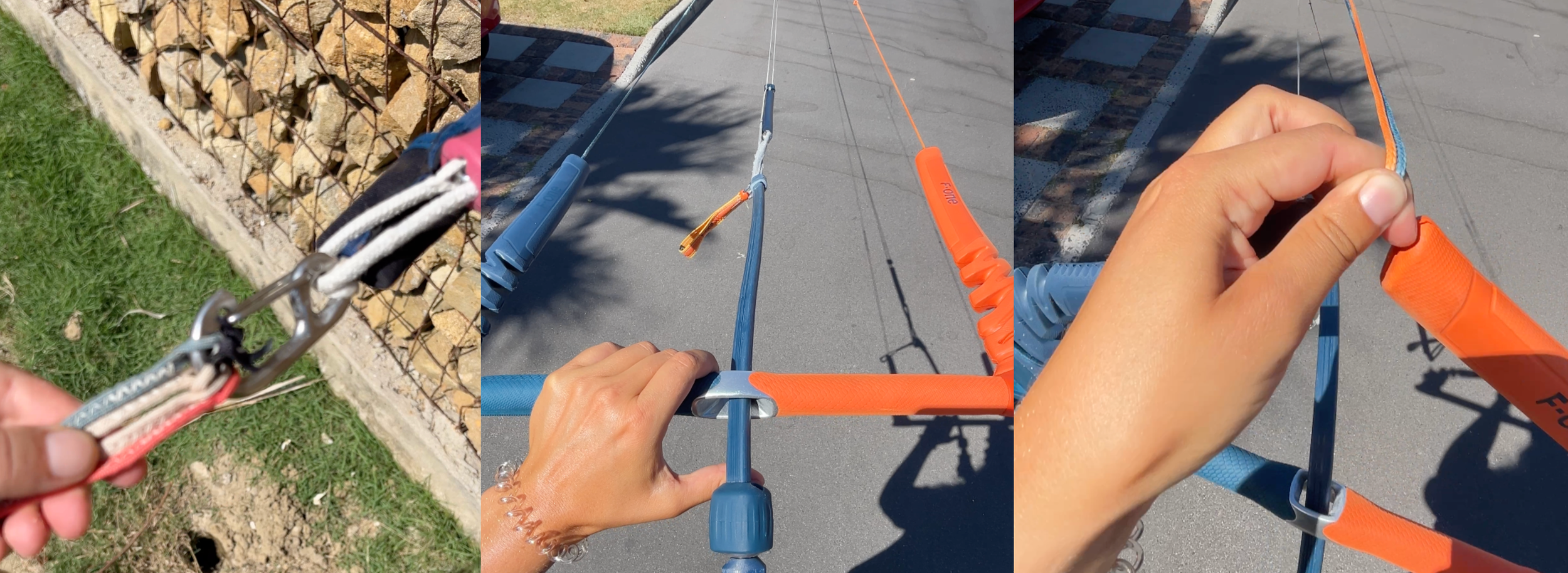
How do you check if your kite lines are even?
You do not need a fancy workshop. You need a wooden post or a very trustworthy friend.
Walk out your lines completely across the beach, exactly as you would for a normal launch. Attach all four pigtails to the post or your friend. Walk back to your control bar, hold the chicken loop, and pull the bar all the way in.
Now look closely:
Bar position: The control bar should be perfectly straight and sit no more than 5cm above the chicken loop. If the bar is crooked, one side is longer.
Line tension: With the bar pulled in, all four lines should feel equally taut. You can also release tension slightly and check for slack. The line with more sag is longer. Check the steering lines and center lines sperately.
Line condition: While you're there, look for fraying, knots, or any visible wear. A line that's starting to fray is a safety issue, not just a performance one.
This takes two minutes. Do it before you pump up. Not after you've been frustrated for an hour.
How do you fix uneven kite lines?
Almost every modern kite bar has adjustment options built in specifically for this. You do not need to buy new lines yet.
Under the floaters: Pull back the floaters on the ends of your bar. Underneath, you'll usually find a series of knots on the leader lines. Moving your steering line attachment to a different knot artificially lengthens or shortens that line.
Move toward the kite: makes that steering line shorter
Move away from the kite: makes it longer
Adjust one side only if the kite is pulling to one direction
On the kite itself: The pigtails at the kite end also have multiple knot positions for fine-tuning turning speed and bar pressure. Moving connections here achieves the same balancing effect.
Uneven centre lines: This is trickier. A small extra pigtail or a replacement section can help, but if your centre lines have genuinely stretched to the point of being significantly uneven, it's worth considering a new set. New lines on an old kite can feel like a completely different kite.
After any adjustment, do the post check again to verify your work.
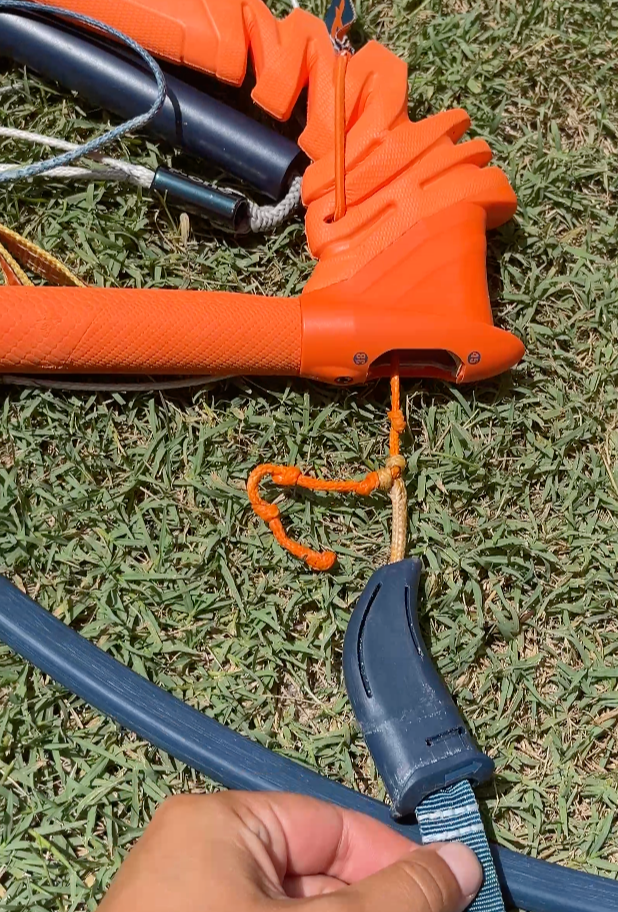
What is the trim strap and when should you use it?
Checking and adjusting lines on the beach handles your baseline setup. The trim strap, the strap above your bar, handles everything that happens while you are actually riding.
The trim strap effectively lengthens or shortens your centre lines on the fly. When you pull it (shorten the centre lines), the angle of attack flattens and the kite dumps power. When you let it out (lengthen them), the kite generates more lift.
Pull trim when: the wind picks up, you're getting overpowered, or your bar feels heavy and hard to hold in.
Let trim out when: the wind drops, the kite starts frontstalling or backstalling during your session, or your arms are fully extended and you're still struggling for power.
What most kiters get wrong:
Pulling trim in light wind: This flattens the kite too much and causes a frontstall. In light wind, trim should be fully out so the kite can generate maximum lift.
Forgetting the trim strap entirely: If you constantly find yourself needing more trim than your strap allows, that is a signal your lines need attention. The strap is for session management, not for compensating for stretched lines permanently.
Over-trimming: Pulling it all the way in makes the kite fly weirdly flat and can actually cause more issues than it solves in gusts.
Use the trim strap to keep your bar in the sweet spot throughout the session. It exists for a reason.
When is it time to replace the lines entirely?
Adjusting the knots can fix uneven stretch but it cannot fix everything. Some situations mean it is time for a new set.
Replace your lines when:
Fraying is visible anywhere along the line, especially near the pigtail connections
The centre lines have stretched so far that even maximum pigtail adjustment cannot compensate
You have actual knots in the lines from a tangle that will not fully release (knots permanently weaken the line at that point)
One line has clearly more wear than the others, indicating uneven load distribution across your sessions
New lines are not expensive relative to the rest of your gear. A full set typically costs less than a session in a new location. If your kite is otherwise in good shape, fresh lines can completely transform how it flies. Most kiters are surprised by how dramatic the difference is.
Check out Your kite is not a rental for the broader mindset on treating your gear with respect.
How often should you check and trim your lines?
Make it a regular habit, not a panic activity.
A good routine: every 5 to 10 sessions, take two minutes to tie your lines to a post and pull the bar. Add it to whatever you already do for gear care. Rinsing the bar with fresh water after a session, checking for frays, letting the kite dry properly before packing it away.
If you're riding frequently (multiple times a week), check more often. Salt, UV, and mechanical load all degrade lines faster than most kiters expect. A session in strong wind loads the lines far more than a light-wind day.
The best time to do a full check? A no-wind day when you're doing general maintenance anyway. Kite care: Making the most of a wind-free day has a full no-wind maintenance checklist you can run through.
Time to tune your gear
Kitesurfing is chaotic enough with unpredictable conditions. You do not need to add an unbalanced, badly tuned bar to the list. You’ll get frustrated.
A kite that backstalls or pulls sideways does not just ruin the session. It drains your energy, makes progression nearly impossible, and puts extra stress on your body as you constantly compensate. Once you fly a properly tuned kite, you will wonder what you were putting up with before.
Just remember that pulling harder on an untuned bar only guarantees you will look silly while crashing.
xox Berito
Quick answers
-
The clearest signs are backstalling when you pull the bar, the kite drifting to one side unprompted, and sluggish turning response. Confirm it with a post check on the beach: attach all four lines, pull the bar in, and check whether it sits straight and level.
-
There is no fixed schedule. It depends on how often you ride and in what conditions. Inspect them regularly for fraying and uneven length. Most kiters riding a few times a week get 1 to 3 seasons from a set. If you cannot achieve even tension through knot adjustments anymore, replace them.
-
Bar trimming (adjusting knots on the pigtails) sets your baseline static line length before you launch. The trim strap adjusts your centre line length dynamically while riding to manage power. You need both. One does not replace the other.
-
Adjust only the left steering line. Move the pigtail connection one knot position to lengthen that side. Do a post check after each adjustment until the bar sits straight. If it still pulls after multiple adjustments, check whether your kite's canopy itself is asymmetric (possible if it has taken impact damage).
-
Only partially. The pigtail knots adjust steering line length, which compensates for centre line stretch up to a point. If your centre lines have stretched significantly beyond what the knots can compensate for, you need a new set of lines or a centre line extension.
-
Briefly, and with caution. But it is not something to ignore. Uneven lines mean your safety system may not release correctly when you need it. Backstalls and side-pulls also increase crash risk. Fix it before your next proper session.