
How does wind happen?
“Wind happens because the sun heats the earth unevenly, which creates areas of high and low pressure, and air always moves from high pressure to low. The bigger that pressure difference, the harder it blows. Everything else, the gusts, the evening drop, the reason one beach beats the one next to it, is that same rule shaped by whatever the air has to cross on the way.”

Every kitesurfer has stood on a beach staring at a flat grey sea, refreshing an app, willing something to arrive. And every kitesurfer has also stood on that same beach two hours later getting absolutely hammered by wind that showed up out of nowhere. We spend an enormous amount of our lives waiting on something invisible, and most of us have never really been told what it actually is.
I did not learn any of this in a lesson. I learned it slowly, by being wrong on the beach over and over, and by eventually getting curious enough to ask why. It turns out wind is not complicated. It is one rule, repeated at different sizes, and once you have that rule in your head everything else about weather starts making a lot more sense. So here is the whole thing, without the textbook.
How does wind happen?
Wind happens because the sun does not heat the earth evenly. Some surfaces warm up fast, some stay cool, and that difference creates areas where the air is heavier and areas where it is lighter. Air always moves from the heavy side to the light side, and that movement is wind. That is genuinely the entire mechanism.
Everything you have ever heard about weather is a variation on that sentence. A thermal on your local beach and a hurricane in the Atlantic are the same process running at wildly different sizes. Nothing else needs to be added. What changes is how big the difference is and what the air has to travel over to get there.
What actually causes wind to move?
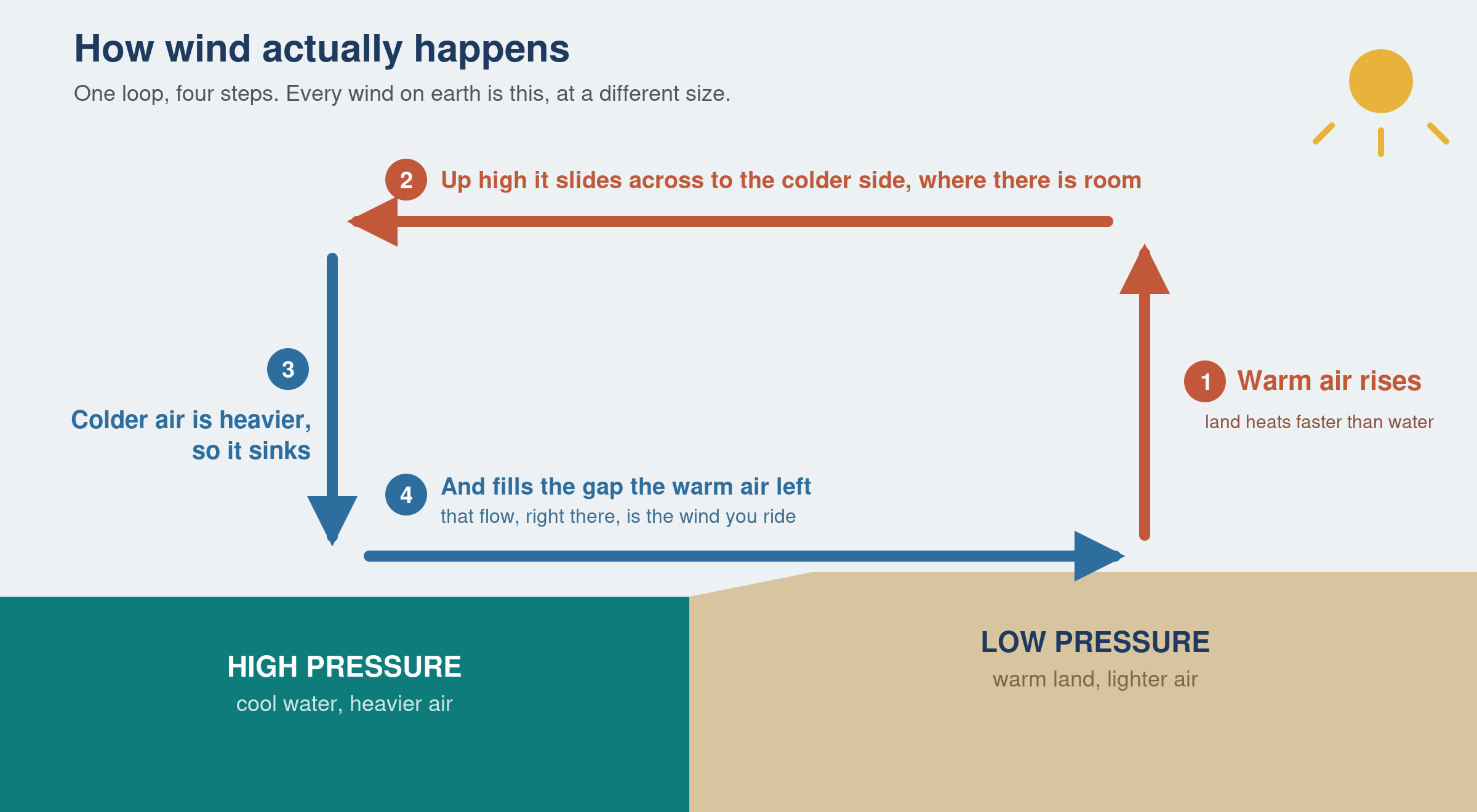
Warm air is lighter. When the sun heats a patch of ground, the air sitting on it warms, expands, and rises. That rising air leaves less weight pressing down behind it, and we call that low pressure. Somewhere else, air is cooling and sinking, piling up and pressing down harder, and that is high pressure. The air at ground level then does the obvious thing and slides from the high side toward the low side to even things out. That slide is the wind you are standing in.
The important part, and the part that actually predicts your session, is the size of the difference. A small pressure difference gives you a lazy, pleasant nothing. A big pressure difference squeezed into a short distance gives you the kind of day where you rig your smallest kite and still wonder if you have made a mistake. Meteorologists call this the pressure gradient, and it is the single most useful concept in this whole post. Big gradient, strong wind. Small gradient, stay home.
There is one complication worth knowing and then leaving alone. The earth is spinning underneath all this moving air, so wind does not travel in a straight line from high to low. It gets bent. In the northern hemisphere it bends to the right, in the southern hemisphere it bends to the left, and the effect is called Coriolis. This is why weather systems spiral instead of collapsing straight inward. You do not need to calculate anything. You just need to know that the air is curving, which is why the wind direction around a pressure system is not simply pointing at the middle of it.
The last thing to hold onto is that this is happening at three sizes at once:
Global: the huge belts of wind that make trade winds a thing.
Regional: the high and low pressure systems that move across your country over days.
Local: the daily heating cycle at your own beach.
Most of the arguments on the beach about whether the forecast is lying come down to people looking at one of those scales and getting surprised by another.
Why does wind speed up and slow down through the day?
Because the local scale runs on the sun, and the sun clocks off. Land heats up much faster than water during the day, which builds a pressure difference between the two and pulls air in off the sea. That is the sea breeze most of us live on. When the sun drops, the land cools quickly, the difference collapses, and so does your session.
That is the short version, and it is also the single most searched question about wind that exists. The full answer includes why some spots do exactly the opposite after dark, which is genuinely useful if you ever want to ride at sunset. I pulled that apart properly in why the wind dies at night.
Why is wind smooth some days and gusty on others?
Because moving air is not a solid block. It is a fluid, and fluids tumble when they hit things. Wind arriving across open water for fifty kilometers gets to organise itself into something smooth and predictable. Wind arriving over a town, a tree line, a dune, or a row of buildings gets chewed up, and what reaches your kite is a mess of fast bits and slow bits arriving in no particular order.
That is why the same twenty knots can feel like a gift on one beach and a punishment on another. Gusts are not bad luck and they are not the forecast being wrong. They are the texture of the air, decided almost entirely by whatever it crossed on the way in. If you want the version with what to do about it, including how to size your kite for a punchy day, that is all in what causes gusty wind.
Why is one beach windier than the one next to it?
Because air slows down when it drags across something rough and speeds up when it does not. Water is smooth, so wind holds its speed across it. Land is rough, so wind loses speed over it. Trees, dunes, buildings and hills all steal energy out of the flow, and they do it unevenly.
Then geography does the other half of the job. A valley squeezes air into a narrower space, and air that gets squeezed has to speed up. A headland does something similar around its edge. A hill upwind of you does the opposite and leaves a hole in the wind that can last for hundreds of meters. This is why your spot has a good direction and a rubbish direction, and why the beach twenty minutes down the coast can be having a completely different day. There is a lot more to this than fits here, and it is one of the most useful things a rider can learn about their own spot, so I gave it its own post: why some places are windier than others.
Can you see wind coming before it arrives?
Yes, and this is where knowing the mechanism actually pays you back. Because wind comes from pressure differences, and pressure systems are large and slow and mapped, you can watch one forming days before it reaches you. A forecast is not a prophecy. It is a model looking at where the high and low pressure are sitting, working out how big the gradient between them is, and telling you what that should produce at ground level.
Which also explains why forecasts get your beach wrong so regularly. The model is good at the regional scale and much worse at the local one, and the local one is the one you are standing in. Learning to read the gap between those two is the actual skill, and it is the thing that stops you driving an hour for nothing. That whole skill lives in how to read a kitesurfing forecast.
How much of this do you actually need to know to kite?
Honestly? None of it. Plenty of people ride brilliantly for years without ever thinking about pressure gradients, and nobody has ever landed a better kiteloop because they understood Coriolis.
But there is a difference between riding and reading. Once you know that wind is just air moving from heavy to light, and that the ground decides what shape it arrives in, you stop being surprised. You stop thinking the forecast lied to you and start noticing that the wind is doing exactly what it always does, at a beach that happens to be shaped a certain way. You start choosing better days, showing up at better times, and picking the right kite more often than you get it wrong.
The last piece, and the one that decides more sessions than anything else, is not how strong the wind is but where it is coming from. Onshore, offshore and sideshore all turn the same twenty knots into three completely different days, and that deserves its own explanation: which direction it arrives from.
Understanding wind will not make it show up any more often.
xox Berito
Quick answers
-
Wind happens because the sun heats the earth unevenly, creating areas of high and low pressure, and air moves from high pressure to low.
-
Because air is trying to even out a pressure difference, and the bigger that difference is over a short distance, the stronger the wind.
-
Warm air rises and leaves low pressure behind, cool air sinks and creates high pressure, and the air moving between them at ground level is wind.
-
Uneven heating from the sun, shaped by the earth's rotation and by whatever surface the air has to travel across.