
Gusty winds and how to actually ride them
“Gusty wind is wind that arrives in uneven bursts instead of a steady flow, caused by air being broken up by terrain, temperature differences or weather fronts. Rig for the gusts rather than the lulls, take a bigger board, and use your legs and your bar as shock absorbers. If the gap between the average and the gusts is more than about ten knots, expect a workout rather than a session.”
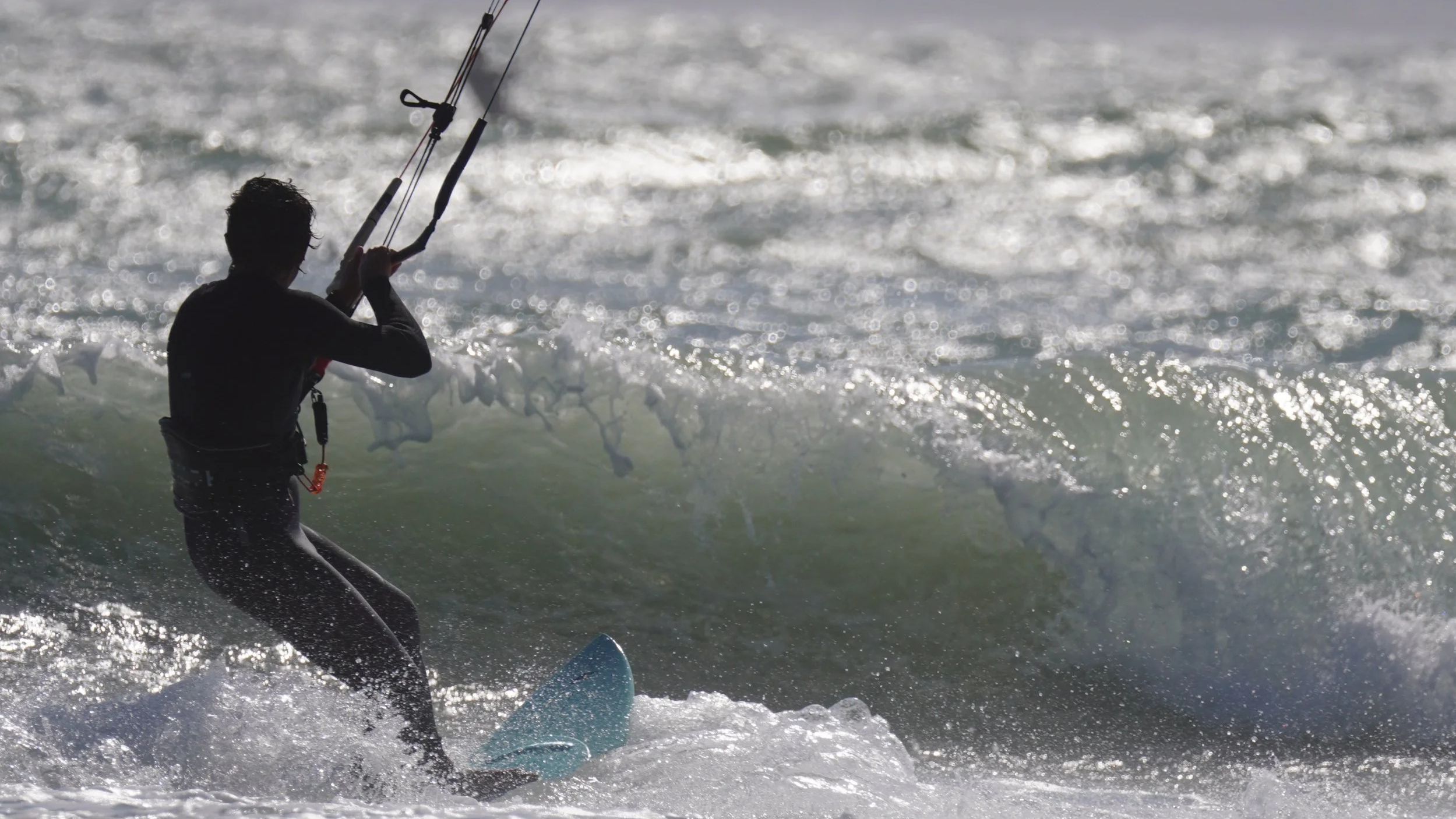
We all know the feeling of staring at a wind app and seeing perfectly green numbers. You rush to the beach, pump up your kite, hit the water, and then spend the next twenty minutes riding what feels like a highly caffeinated mechanical bull. The wind pulls your arms out of their sockets one second and drops completely the next, leaving you to faceplant into the water.
Welcome to the exhausting world of gusty wind. We get so obsessed with the average wind speed on our screens that we ignore the actual quality of the wind. A solid twenty knots is magic. A session swinging between twelve and twenty eight knots is survival. The good news is that riding gusty wind is a technical skill, not a personality trait of the wind gods, and it can absolutely be learned.
What is gusty wind?
Gusty wind is wind that arrives in short, uneven bursts instead of a steady flow, with the speed spiking and dropping again within seconds. A gust is the spike. A lull is the hole that follows it. That is the whole definition.
It is worth separating a gust from a squall, because people mix them up constantly. A gust is brief, a few seconds of extra speed, and then it is gone. A squall is a sustained blast that lasts minutes, usually arrives with a dark cloud, and is an entirely different level of problem. Gusts make your session hard work. Squalls make your session over.
Smooth air lets your kite sit calmly in the window. Gusty air makes it bounce around like a caffeinated puppy.
What causes gusty winds?
Air is a fluid, and fluids tumble when they hit things. Anything that disrupts a smooth flow turns it into a mess of fast bits and slow bits arriving in no particular order. There are four usual suspects.
Terrain: hills, dunes, tree lines, buildings. Air crossing them gets chopped up, and what reaches your kite is the wreckage.
Temperature differences: warm air rising off hot land creates upward drafts, and cooler air rushing in to replace it arrives unevenly.
Weather fronts: where two air masses of different temperature and density meet, the boundary throws out gusts.
Jet streams: high altitude wind occasionally dipping down and stirring up the surface flow.
If you want the version underneath all of that, the smooth flow that gusts are a disruption of, it starts with how wind actually happens.
The terrain point is the one that matters most day to day, and it explains why the same twenty knots feels like a gift at one beach and a punishment at the next one over. Wind arriving across fifty kilometers of open water has had time to organise itself. Wind arriving over a town has not. This is also why some spots are gusty almost every single day, which is really a geography problem rather than a luck problem, and I went into that properly in why some places are windier than others.
How can you tell it will be gusty before you drive out?
Look at the gap, not the average. This is the single most useful habit in this whole post and almost nobody does it.
Your app shows a base wind speed and a gust rating. If it says eighteen knots you picture a lovely freeride session, but if the gusts are hitting thirty you are walking into a battlefield. The gap between those two numbers tells you what the session will actually feel like:
A gap of three to five knots: normal, comfortable, ride whatever you would normally ride.
A gap of around eight knots: noticeable, plan to be active on the bar.
A gap of ten knots or more: highly unstable, expect real physical effort.
If the graph looks like a jagged mountain range rather than a gentle hill, prepare yourself for a workout. There is a lot more to pulling a session out of a forecast than this one number, and that whole skill lives in how to read a kitesurfing forecast.
Then check the wind direction against the map. If the air crosses buildings, trees or big dunes before it reaches the water, it will be chopped up no matter how nice the numbers look.
And when you get there, the water tells you the rest. Dark patches racing towards you are gusts you can see coming. Twitchy trees, cauliflower shaped clouds and a suspicious dark line offshore are all free information. You do not need wizard powers, just the habit of looking for thirty seconds before you rig.
What does a gust actually do to your kite?
Your kite does not care about the wind speed on your phone. It cares about apparent wind, which is the true wind combined with your own board speed. That is why gusts feel so violent.
When a gust lands, the kite surges forward, your lines load up, and you accelerate whether you asked to or not. Then the lull arrives, your lines go slack, the kite sinks back through the window, and if you are slow on the bar it can backstall completely. The symptoms are always the same:
Power spikes that blow you off your edge.
Steering that feels fast one second and sluggish the next.
Jumps that send you to the moon and land you like a brick.
Understanding this is what turns the reaction from panic into technique. You are not fighting the wind. You are managing a kite that keeps changing how much power it has.
What size kite should you use in gusty wind?
Rig for the gusts, not for the lulls. This is the golden rule and it feels wrong every single time.
The temptation is to pump up something big so you can keep riding through the dead patches. Do that and the first serious gust will rip you off your edge, loft you, and drain your energy while you fight to hold the kite down. Instead, rig a kite you can comfortably handle at the peak speed, and accept that you will sink a bit when the wind drops.
Sinking is annoying. Being overpowered is dangerous. That is not a close call.
Then fix the sinking problem with the board instead of the kite:
Size down the kite: pick for the gusts, every time.
Size up the board: the extra surface area keeps you planing through the lulls while your small kite takes a nap.
Use the trim strap actively: pull it in when the base wind creeps up, do not just set it once and forget.
Pick a kite with real depower range: some shapes handle spikes far better than others.
If you are unsure where your sizes sit in the first place, that is worth fixing before a gusty day rather than during one: how to choose the right kite size.
How do you ride through gusts and lulls?

Two things move constantly: your body and your bar. Lock either one in place and the wind wins.
Your legs are the shock absorbers. When you see that dark patch coming, get ready before it arrives. Drop your hips low, bend your back knee deeply, and drive through your heel to hold your edge against the extra power. Then, the moment the lull hits, do the opposite. Your instinct will be to keep pushing on your heels, and that instinct will sink you. Stand a little taller, release the hard edge, and let the board run flat. You are trading upwind angle for speed so you stay on the surface.
That constant switch between edging hard and flattening out is exactly why gusty days destroy your legs. Doing it deliberately still burns, but it burns far less than being thrown around rigidly.
Your bar is not a handle to hold onto. The most common mistake is the death grip: a gust arrives, panic arrives with it, and the bar gets hauled in against your chest. That gives the kite maximum power at the exact moment you want less of it.
Gust lands: push the bar away and let the wind spill over the canopy.
Lull arrives: pull the bar in slightly to catch whatever is left.
Through the lull: actively fly the kite, do not park it and hope.
Always: relaxed arms, elbows soft, small corrections.
Working the kite gently up and down through a lull generates your own apparent wind, which is how you make power when the sky refuses to provide any. Parking the kite at forty five degrees and waiting is how you end up swimming.
Can gusts ever work in your favour?
Yes, and this is the part nobody tells beginners. A gust is a free ramp if you time it.
Spot the gust line coming across the water, load your edge early, and send the kite just before it reaches you rather than as it hits. Done right you ride the gust upward and get the biggest boost of your session. Done wrong, meaning you hammer the bar the second you feel power, you get nothing but a hard landing.
The other half is what happens at the top. Sheet carefully on the way up, then adjust in the air depending on whether the gust holds or dies underneath you. Gusty days give you the highest jumps and the worst landings, often within a minute of each other.
You can also train for this off the water. Stronger ankles and hips make the board chatter much less exhausting, which is one of the more direct returns on balance training for better kitesurfing.
Which kite spots are the gustiest?
Some spots are famous for it, and it is always the same cause: terrain squeezing and breaking up the flow.
Tarifa, Spain: the Strait of Gibraltar funnels the wind between mountains. A dream for pros, a nightmare if you are not ready.
Hood River, USA: thermals plus the steep walls of the Columbia River Gorge. Beautiful, and completely unpredictable.
Cape Town, South Africa: the Cape Doctor clears the smog and wrecks your session, because Table Mountain spins the air into a vortex on its way down.
None of these are bad spots. They are spots where you rig differently and pick your day.
When should you just not go out?
When the gap gets big enough that you are riding the peaks rather than the average, and the peaks are above what you can hold down.
That is a judgement call, not a number, and it moves as you improve. What does not move is the rule about what you attempt. A gusty day is not the day for a new unhooked trick. Trying technical moves in twenty five knot gusts is an efficient way to dislocate a shoulder. Use those sessions for board control, stance and upwind riding instead, and lower the bar on what counts as a good session.
Break it up too. Ride forty minutes, come in, drink something, let your legs recover. You do not owe the beach three straight hours just because you drove there.
If you want the honest version of where the upper limit sits and how to know you have reached it, that is its own conversation: how strong is too strong.
Gusty wind is a miserable teacher and a very effective one. It forces you to become an active rider instead of a passenger, and everything you learn holding an edge through a gust makes the smooth days feel absurdly easy.
Blaming the wind is still completely valid when nobody actually saw you crash.
xox Berito
Quick answers
-
Gusty wind is wind that arrives in short uneven bursts rather than a steady flow, spiking and dropping again within seconds.
-
Turbulence, usually from air flowing over terrain like hills, dunes or buildings, and also from temperature differences and weather fronts breaking up a smooth flow.
-
Rig for the gusts rather than the average, so go one size down and take a bigger board to keep you planing through the lulls.
-
Stay active on the bar, push it away in the gusts and pull it in through the lulls, use your legs as shock absorbers, and keep away from the shore where the air is dirtiest.
-
Tarifa, Hood River and Cape Town are three of the most notorious, because mountains and gorges funnel and disrupt the wind.