
“Colombia has strong trade wind from December to April, a Caribbean coast full of spots and two inland lakes that work when the coast does not. Salinas del Rey and Puerto Velero are the easy choice, Cabo de la Vela is the wild one, and Lago Calima and Chivor are the surprise. Add the food, the music and the culture, and it is one of the most underrated kite trips out there.”
When kiters plan a winter trip, the list is usually the same. Brazil, Cape Town, maybe the Caribbean islands. Colombia hardly ever makes it, and I think that is a mistake. The trade wind on the Caribbean coast is strong and steady, the spots range from flat lagoons to proper waves, and one of the best big air riders in the world grew up kiting in a fishing village in the desert. On top of that you get culture, great food and some of the friendliest people you will meet on any trip. Good wind, good food and a country that still feels like a discovery. Who does not want that?
Where are the best kite spots in Colombia?
Most of the kiting happens on the Caribbean coast, in two regions. Atlántico, west of Barranquilla, is home to Salinas del Rey, Puerto Velero and a string of quieter beaches. Further east, the desert peninsula of La Guajira has Cabo de la Vela, Mayapo, Riohacha and Punta Gallinas, and some of the strongest wind in the country.
Then there are the spots people forget. Cartagena has light wind right next to the old city and a string of islands just off the coast. The island of San Andrés has turquoise water and reef. And inland, high in the mountains, Lago Calima near Cali and the Chivor reservoir near Bogotá give you freshwater kiting with a completely different view.
When is the kite season in Colombia?
The main season runs from December to April, when the northeast trade wind is at its strongest along the Caribbean coast. In Atlántico it blows side onshore at around 20 to 25 knots most days, from late morning until sunset, and stronger days are common. January to March is the most reliable stretch, which is also when the GKA world tour has stopped at Salinas del Rey.
La Guajira gets wind for most of the year. Only October and November are weaker and wetter, and that is also when the desert tracks to Cabo de la Vela and Punta Gallinas can turn to mud. The lakes follow their own rules. Lago Calima blows for most of the year in the afternoon, and Chivor is at its best around December and January.
If you want to see how Colombia fits into a full winter of kite trips, have a look at best kitesurfing spots by month.
What makes the Atlántico coast so good?
The wind is strong, steady and side onshore, and within a short drive you can pick between waves and flat water. That mix is rare. Most coasts give you one or the other.
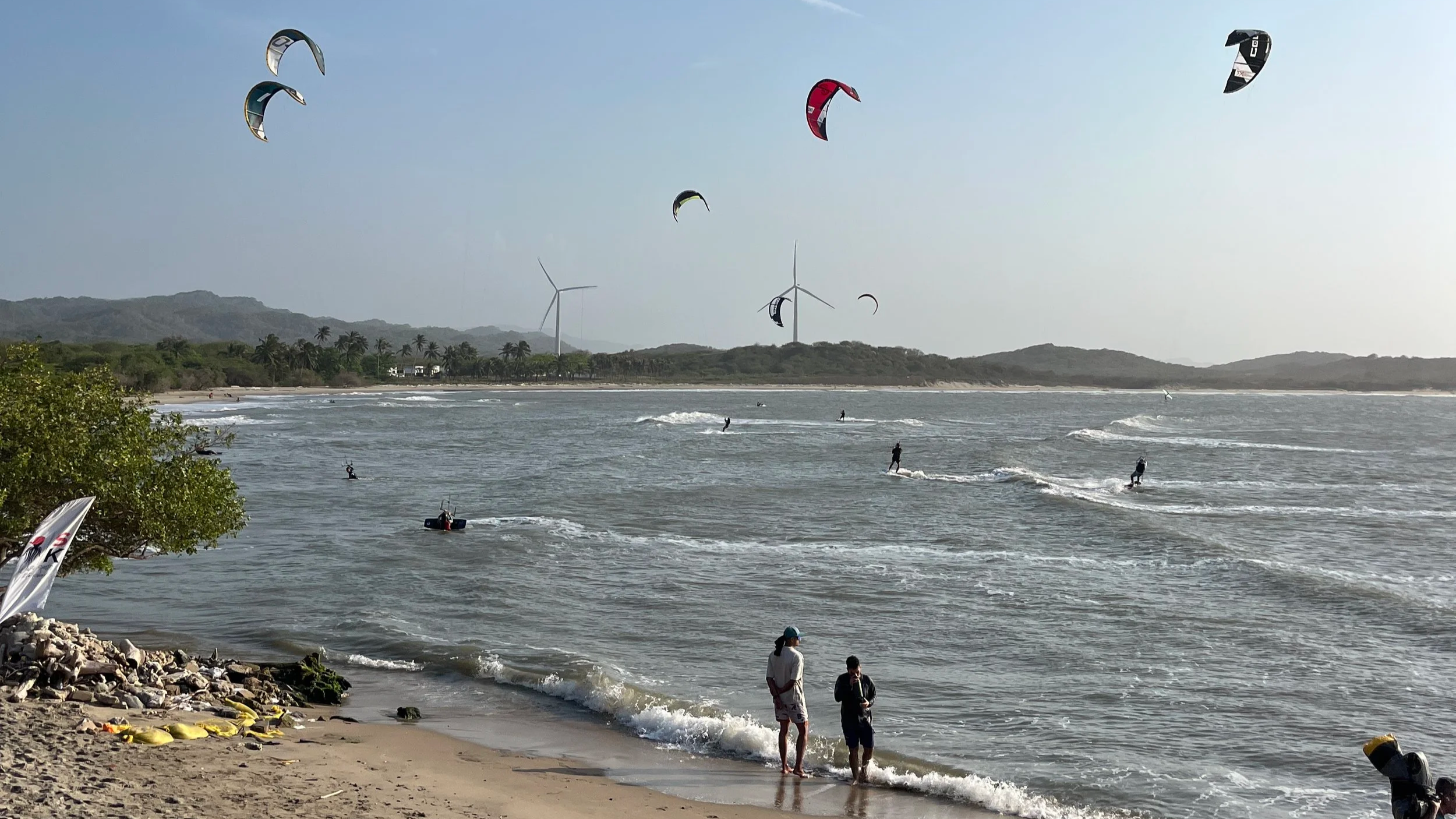
Salinas del Rey is the big name, and the GKA came here for a reason. I spent three months here and absolutely loved it. It is not only a spot for advanced riders, but it is a spot you need to get to know. Where to go in, where to come out and when. The waves outside can be big, but there is also a bay without waves where you can ride flat water. There is a rock, but if you know where it is, you are mostly fine. And there are a lot of kite schools, so there is always someone around who can help you. I wrote a full post about it, so if you want to know whether Salinas del Rey is worth the trip, start there.
Puerto Velero, about 10 km up the coast, is great for beginners. Flat water, small chop and a lot of space. It can be a bit gusty sometimes, because the wind comes over land before it hits the spot, but on a good day it is amazing. It is also more remote, so there is not much to do around it once the wind drops.
And then there are the quieter ones. Punta Astillero is a favourite. It has a lagoon where you can ride flat water, and lovely waves on the ocean side. Palmarito, a few kilometres from Salinas, has fewer riders and slightly softer wind, and Puerto Colombia near Barranquilla has waves on the ocean side and a flat lagoon close by. Keep an eye out for branches there, because the Magdalena river carries a lot of wood into the sea.
Which downwinders should you not miss?
This coast is made for downwinders. The wind blows along the beach, the coast is long and mostly empty, and there is always another beach to land on. Two are a must.
Barranquilla to Salinas del Rey. You start near the city and ride past Puerto Colombia and Puerto Velero, with the coastline slowly getting quieter and greener as you go
Salinas del Rey to Punta Astillero. Lovely waves the whole way. They can get big and strong, so be careful and know your limits
Want a long one? The whole stretch between Barranquilla and Cartagena is one big downwinder playground. Ride from Barranquilla or Salinas all the way to Cartagena, or pick any section in between.
Do not do these on your own. Arrange a pickup at the end, ride with at least one other kiter and check where you can and cannot land before you go. Several schools around Salinas run guided downwinders with a car following along the coast, and that is the easiest way to do it.
Why is Cabo de la Vela on every kiter’s wish list?
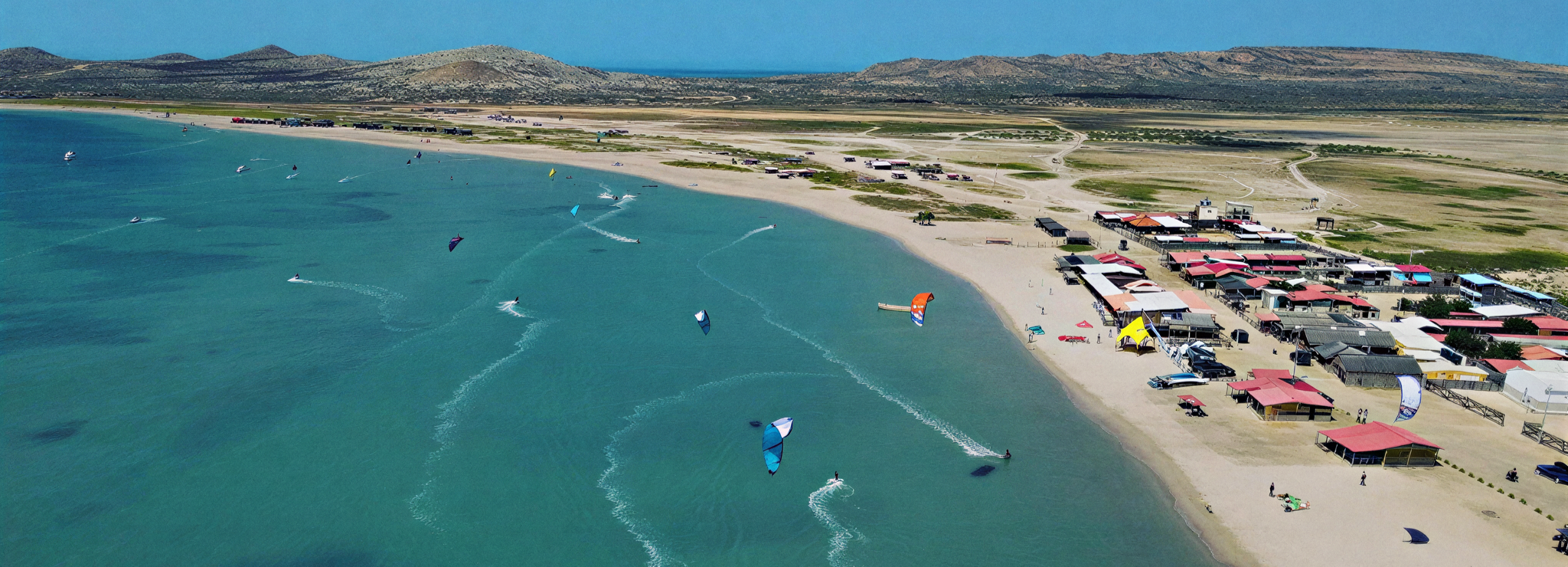
Because it is the real deal. Cabo de la Vela is a small fishing village in the La Guajira desert, home to the Wayuu people, where the wind blows at 25 to 35 knots for most of the year over a wide, shallow and flat bay. For speed, big air and flat water freestyle, few places in the world come close.
It is also the home of Beto Gómez, a Wayuu kiter who grew up here and finished fourth at his first King of the Air. A seriously good kiter, period. When a village this small produces a rider like that, you know the wind is serious.
Getting there takes some effort. You fly to Riohacha, drive to Uribia and then take a jeep for about three hours across desert tracks. Cabo is not as remote as it used to be, there is water and electricity now, but it is still back to basics. Simple guesthouses, hammocks and not much else. And if you do not like fish, be warned. It is rice and fish, every day. The wind in the bay is side offshore and can be gusty, so ride with a school or make sure there is a boat around. It is not easy, and that is why it still feels like an adventure.
What else is there in La Guajira?
More than most people know. Mayapo, about 30 minutes from Riohacha, is a calmer option with moderate waves and, in a rainy year, a shallow flat lagoon just north of the beach. It is a great place to learn or to warm up before Cabo. The beach in Riohacha itself has waves and is better for experienced riders.
If you want to go further, Punta Gallinas, the most northern point of South America, has flat lagoons and big dunes, about four hours past Cabo de la Vela by jeep. Local guides also talk about Pusheo near Manaure as the windiest spot in the country. Both are for kiters who like their trips raw.
Can you kitesurf in Cartagena?
Yes, but lighter. La Boquilla, about 15 minutes by taxi from the old city, has a wide beach and calm, shallow water, with several kite schools along the sand. The wind is usually 10 to 20 knots from December to March, so bring a bigger kite.
Cartagena is not where you go for the strongest wind. It is where you go when you want to kite in the afternoon and walk through one of the most beautiful old cities in South America in the evening. It is also the easiest international airport for the coast, with Salinas del Rey only about an hour and fifteen minutes away by bus.
The real hidden gem is in front of the city. Off the coast lie the Rosario Islands, and you can take a boat trip of around five days to hop between them. The wind is light, so bring your biggest kites and hope for a good forecast. But if you can kite there, it is absolutely worth it.
Is San Andrés worth it for kitesurfing?
Yes, it is amazing. San Andrés is a small island in the Caribbean, closer to Nicaragua than to the Colombian mainland, famous for its sea of seven shades of blue. Riding over that water is something else. The wind blows from roughly December to July, usually between 10 and 20 knots, so it is a lighter, more relaxed kite trip than the mainland coast, and you can do a downwinder along the island.
The town beach is easy to launch from but busy, so it is not ideal if you are still learning. The south side of the island has clearer water and more space, but watch out for boats and jet skis. Avoid weekends and holidays, when half the country seems to be on the island. Unlike the mainland coast, San Andrés sits in the hurricane belt, so keep an eye on the forecast if you go late in the year. There are direct flights from the main Colombian cities, and you pay a tourist card fee on arrival.
Can you kitesurf inland in Colombia?
You can, and this is the part almost nobody knows about. Colombia has two inland spots in the mountains that work when you are far from the coast.
Lago Calima, about three hours from Cali, is a big reservoir surrounded by green hills. The wind is funnelled between the mountains and builds from around noon until late afternoon, usually 15 to 25 knots, for most of the year. It can be gusty, the water is cooler than the Caribbean and a thin wetsuit is a good idea. The schools and hotels are around the town of El Darién.
Chivor, a reservoir in Boyacá about two and a half hours from Bogotá, is the spot for kiters who live in or pass through the capital. The wind is lighter and starts around ten in the morning, so locals ride big kites of 14 to 16 metres. December and January are the best months. It is not a destination for a whole trip, but if you are in Bogotá with your gear and a free day, it beats sitting in traffic.
Which kites should you pack for Colombia?
For the Caribbean coast you want small kites. On a normal day in Salinas or Cabo de la Vela, a 7 to 9 metre is the one you will use most, and on the strongest days you will be glad you brought something smaller. For Cartagena, San Andrés and the lakes you need more power, so a 12 or bigger, or a foil, makes those lighter days fun.
A small kite of 6 or 7 metres for the strongest days on the coast and in La Guajira
An 8 to 10 as your everyday kite
A 12 or bigger, or a foil, if you plan to ride Cartagena, the Rosario Islands, San Andrés or the lakes
A wetsuit for the lakes only. On the coast you do not need one
A rash guard or lycra for the coast. Bikinis are totally fine, but the sun is strong, so cover up
Booties for the reef on San Andrés
For getting your quiver there in one piece, read how to travel with kitesurf gear.
Why is Colombia more than a kite trip?
Because the time off the water is just as good. The Caribbean coast runs on music, street food and long evenings outside. Try an arepa de huevo, a fried corn arepa with an egg inside, fried fish with coconut rice and patacones, and the fresh fruit juices that are sold on every corner. In February or early March, the Carnaval de Barranquilla, one of the biggest carnivals in the world, takes over the city right in the middle of kite season. In La Guajira you are a guest in Wayuu territory, known for their hand woven mochila bags, and in Cartagena the old city is worth at least one full day without wind.
A few practical things help. Learn some basic Spanish, because outside Cartagena and the kite schools not many people speak English. Bring Colombian pesos in cash for buses, small restaurants and anything in La Guajira, where card machines are rare. Fly into Barranquilla or Cartagena for the Atlántico coast, and into Riohacha for La Guajira. And use the same common sense you would use in any big city, especially at night.
Arepas, trade wind and a desert
Colombia has everything a kite trip needs and gets a fraction of the attention. Start in Atlántico if you want an easy first trip, save Cabo de la Vela for when you are ready for an adventure, and do not forget the lakes. If you like long downwinders and empty lagoons, my Brazil spot guide has plenty more of them.
Just pack your Spanish together with your kites.
xox Berito
Quick answers
-
Yes. The Caribbean coast has strong, steady trade wind from December to April, with both waves and flat water.
-
December to April on the Caribbean coast, with January to March as the most reliable months.
-
Salinas del Rey and Puerto Velero in Atlántico, and Cabo de la Vela in La Guajira.
-
Not really. The wind is strong, gusty and side offshore, so beginners are better off in Mayapo or Puerto Velero.
-
Yes. Chivor reservoir in Boyacá is about two and a half hours away and is best in December and January.
-
Only for the lakes. On the coast a rash guard or lycra against the sun is enough.