
How strong is too strong?
“Quick answer: If you are riding the smallest kite in your quiver and you are still fully sheeted out with the trim strap maxed, the wind has won. Come in.”
Every kitesurfer has stood on the beach, squinting at whitecaps while the wind whistles a slightly terrifying tune in your ears. It is that defining moment of internal debate where your fragile ego fights directly with your natural survival instinct. You see one professional rider out there throwing massive megaloops, and suddenly your trusty nine meter kite feels like a massive parachute waiting to drag you across the sand and into the parking lot.
Understanding exactly when the wind is too strong for your specific skill level is the absolute difference between a legendary session and a very expensive, very painful trip to the local emergency room. It is incredibly easy to get swept up in the hype on the beach, but nature does not care about your enthusiasm.
We are going to look closely at the physics of a heavy gust, the true limitations of your equipment, and why your buddy who says it is totally fine might actually be a complete liar. Let us break down how to manage heavy gales so you stay safe, keep your gear intact, and actually have some fun out there in the chaos.
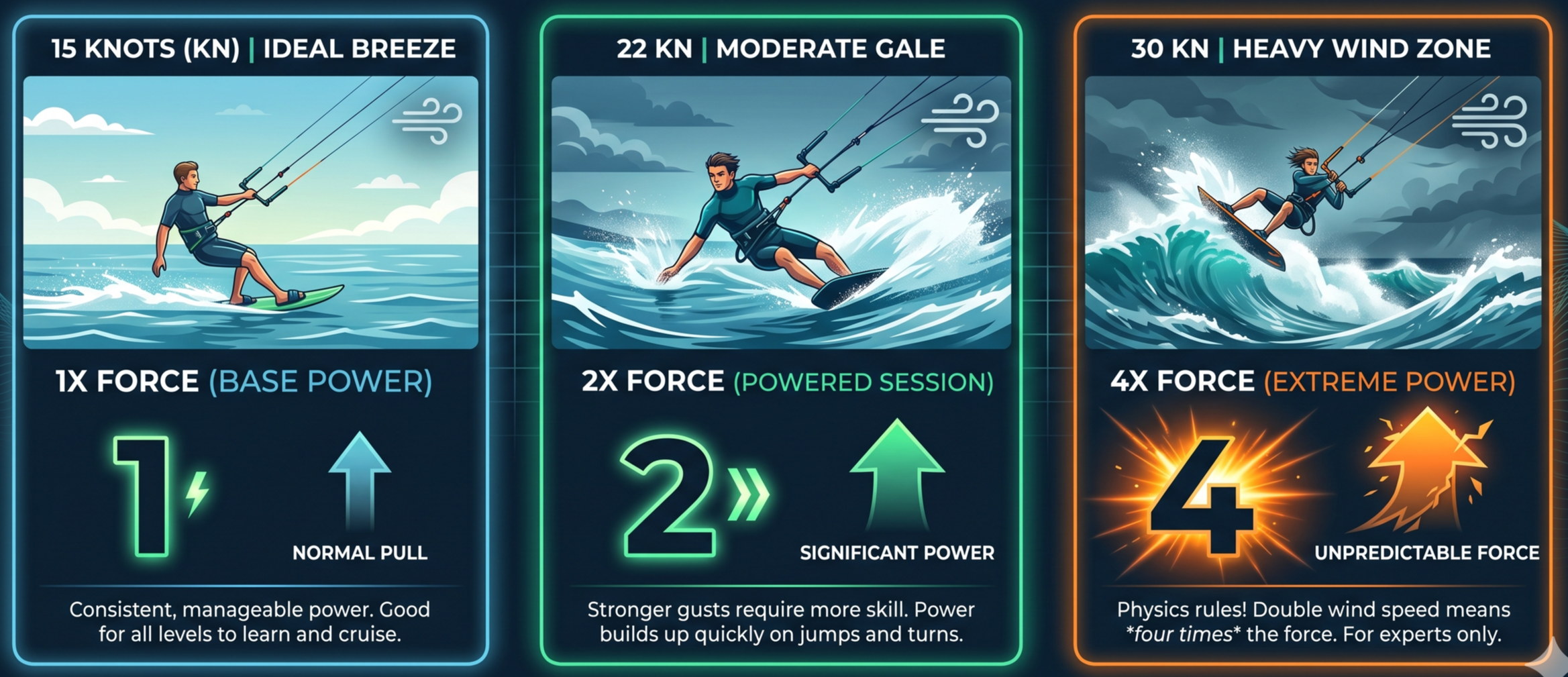
Why does strong wind feel exponentially harder?
The force of wind does not increase linearly. It is exponential. Thirty knots is not twice as powerful as fifteen knots, it is four times as powerful. This is the single most important physics fact in this post, and most riders never learn it.
What this means on the water:
At 18 kn you cruise comfortably with room to react
At 25 kn you are working, but manageable
At 30+ kn the physics actively wants to peel you off the water
At 35 kn even the edge of the wind window gives very little relief
The danger threshold usually starts when the gust spread becomes highly unpredictable. A steady twenty five knots is often much easier to manage than a fifteen knot base that spikes violently to thirty knots every few seconds. These aggressive spikes create a massive amount of apparent wind once you start moving. As you pick up speed the kite generates even more pull, leading to a runaway effect where you feel like you can no longer edge against the power.
Your weight to kite size ratio matters enormously here. A heavy rider might be having the time of their life on a seven meter in thirty five knots, while a lighter rider on the exact same gear would be in a terrifying fight for their life.
What gear do you actually need for high wind?
High wind is the ultimate stress test for your equipment. This is not the day to use that fifteen year old kite with the questionable patch on the leading edge.
The non-negotiable gear checklist:
Immaculate kite: No old canopy, no sketchy lines, no "good enough" repairs
Trim perfectly: Every centimeter of bar throw and depower strap matters
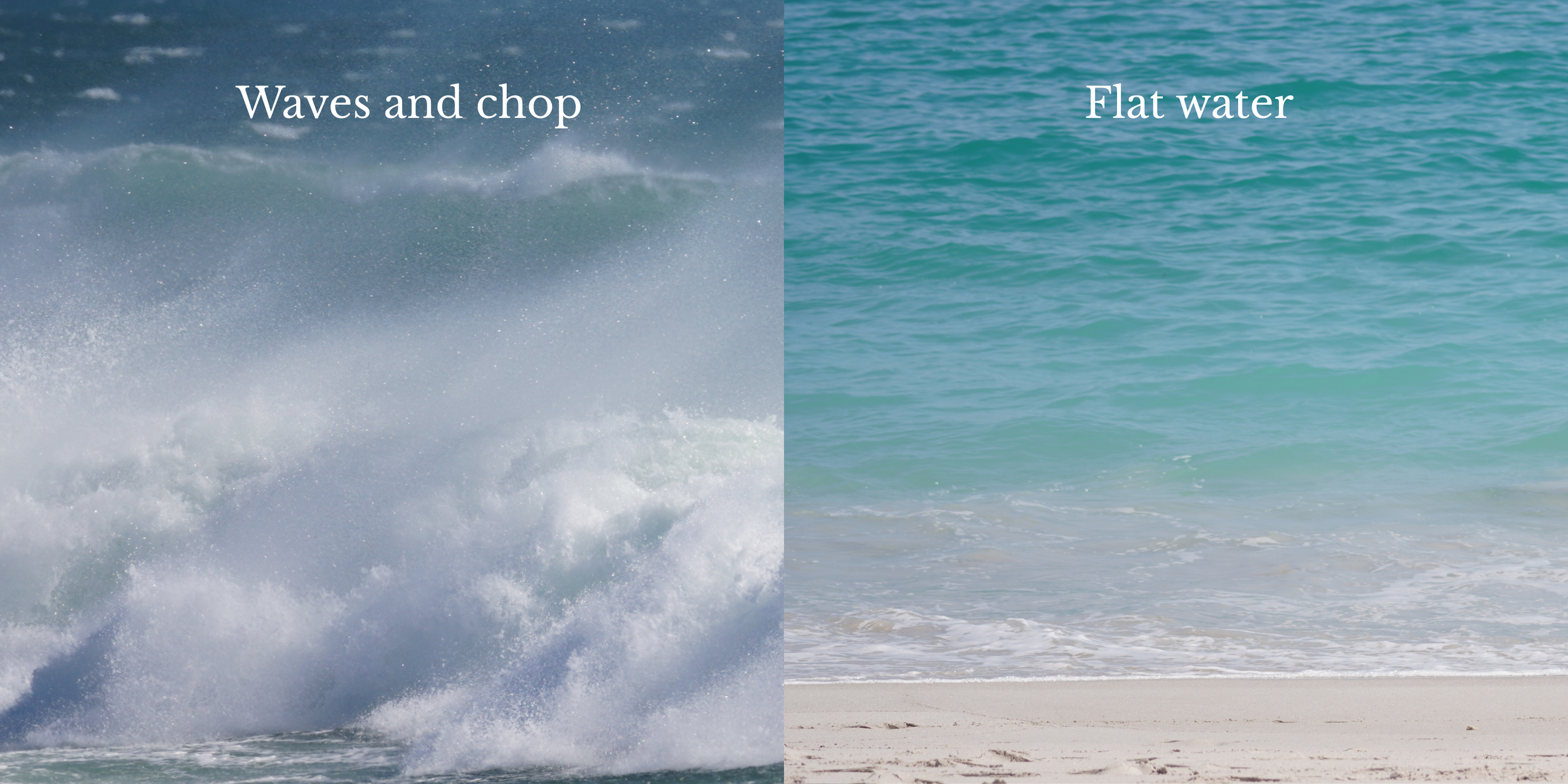
Board rocker: More rocker handles heavy chop. A flat light-wind board bounces like a skipping stone
Small fins: Help control high-speed carving and reduce bounce
Check lines: Look for knots, fraying, or uneven lengths before launching
Shorter lines: Dropping from 24m to 18-20m moves the kite through a smaller arc and keeps it away from the fast air higher up
Your board choice matters as much as your kite size. You need to dig that rail deep into the water to act as a reliable brake. A flat wide board in heavy chop gives you nothing to grip.
For more on picking the right size before you even walk to the water, read how to choose the right kite size, it covers the weight-to-wind logic in detail.
How do you know if the wind is too strong for you?
Be brutally honest. There is absolutely no shame in being a twenty knot maximum rider.
A rough skill level guide:
Beginners: Rarely above 22 kn, things happen too fast for developing muscle memory
Intermediate: Up to 28 kn if the water is relatively flat
Advanced: 30-35 kn with solid self-rescue skills and immaculate gear
Professionals: 35+ kn, and even they have days where they walk away
The self-rescue test:
If the wind increased by another ten knots right now, could you safely pack down your kite in the water and swim in? If the answer is maybe or I hope so, the conditions are too strong for you.
You are over-kited if:
Your trim strap is already fully depowered
Your arms are fully extended and you still cannot hold your edge
Your legs are burning just riding in a straight line
A bigger gust right now would mean triggering your safety release
Whitecaps are the first visible sign. When sea spray starts blowing aggressively off the wave tops, you are officially in the danger zone. The Beaufort Wind Scale gives you actual metrics for what different speeds look like on the water.
What mistakes get people in trouble in strong wind?
Kite too high on the beach
In fifteen knots, a kite parked at twelve o'clock is fine. In thirty knots, it is a dangerous elevator. A small gust can lift you off your feet before you react. Keep the kite low and near the water where you have leverage against the pull.
Panic sheeting
When a big gust hits, human instinct says pull the bar in for balance. In kitesurfing that is the exact opposite of what works. Pulling the bar in adds power, which adds speed, which adds apparent wind, which makes the gust feel stronger. You have to train your brain to push away when fear kicks in.
Common mistakes summary:
Kite too high: Twelve o’clock in heavy wind is a lift, not a ceiling
Panic sheeting: Pulling the bar in when overpowered makes everything worse
Wrong kite size: Rigging for the lulls instead of the gusts
Ignoring gust spread: A 15-to-30 knot swing is far more dangerous than steady 25
No exit plan: Not knowing where you end up if gear fails
For more on reading and surviving unpredictable conditions, what is it about gusty winds explains exactly why gusts behave the way they do. And for spotting a heavy day before you load the van, reading the gust row properly is where that call actually gets made.
How do you make the call not to go out?
The absolute hardest part of kitesurfing is not landing a backroll or a megaloop. It is the walk back to the car without getting wet.
Think consequence versus reward:
At 20 kn: A mistake = a funny splash and a short drag
At 30 kn: A mistake = exhaustion, broken gear, possible injury
At 40 kn: A mistake = broken rib, lost board, kite around a pier
Lower your wind limit if:
You are tired or stressed
You are using borrowed or unfamiliar gear
You have not ridden in a while
The spot is unfamiliar
There is no one else on the water
There is a toxic send-it culture on the beach that suggests you are a coward if you do not go out when the wind is nuking. The ocean does not care about your ego or your follower count.
And before you even get to the wind question, it is worth asking whether you are actually in the right headspace and physical state at all. Am I actually ready to ride today is a proper pre-session framework, not just for heavy days.
Your final wind check
Before you commit to the session, take a moment on the beach and run this scan:
Dark water patches: Frequent dark patches = strong gusts touching down. More patches = more chaos
Watch riders coming off: If the most experienced person on the beach looks wrecked, take note
Sea spray: Blowing off wave tops? You are in the danger zone
Ask the locals: Five minutes of honest conversation beats an hour of forecast scrolling
Kitesurfing is meant to be fun, not a frantic struggle for survival. If you cannot smile while you are riding, it is time to head in.
My grandmother always said that if you cannot hold your umbrella, you should not be out flying a kite, but then again, she never mastered the dark slide.
xox Berito
Quick answers
-
Most beginners should not go out above 22 knots. At that speed, everything happens faster than developing muscle memory can handle. Stick to 15–20 knots until your kite control and self-rescue are solid.
-
If your trim strap is fully depowered, your arms are fully extended, and you are still struggling to hold your edge, you are over-kited. The clearest sign: a bigger gust right now would force you to trigger your safety release.
-
Often, yes. Steady wind is predictable and gives you time to react. A 20-knot base with spikes to 35 knots is significantly harder to manage than a consistent 30. Always check the gust spread on your forecast, not just the average.
-
Yes, significantly. A smaller kite generates less pull at the same wind speed. But it also reduces control and power in lulls. The goal is to rig for the gusts, not the lulls, and compensate with a larger board if needed.
-
Push the bar away from you, do not pull it in. Pushing depowers the kite and spills the excess air. Drop your hips, drive your heels, and edge hard. Counterintuitive, but it is the only move that works.
-
When the gust spread is more than 10 knots above the base, when you are already tired or stressed, when the spot is unfamiliar, or when experienced riders are coming in looking beaten. The wind will be there again. Injuries take longer to recover from than a missed session.