
When your kite turns inside out
“A kite inverts because lines go completely slack after a crash. Do not grab the bar. Swim backward to restore tension, or pull one outer steering line to spin the kite back upright. If that fails, punch the quick release and let the wind roll the canopy back into shape.”
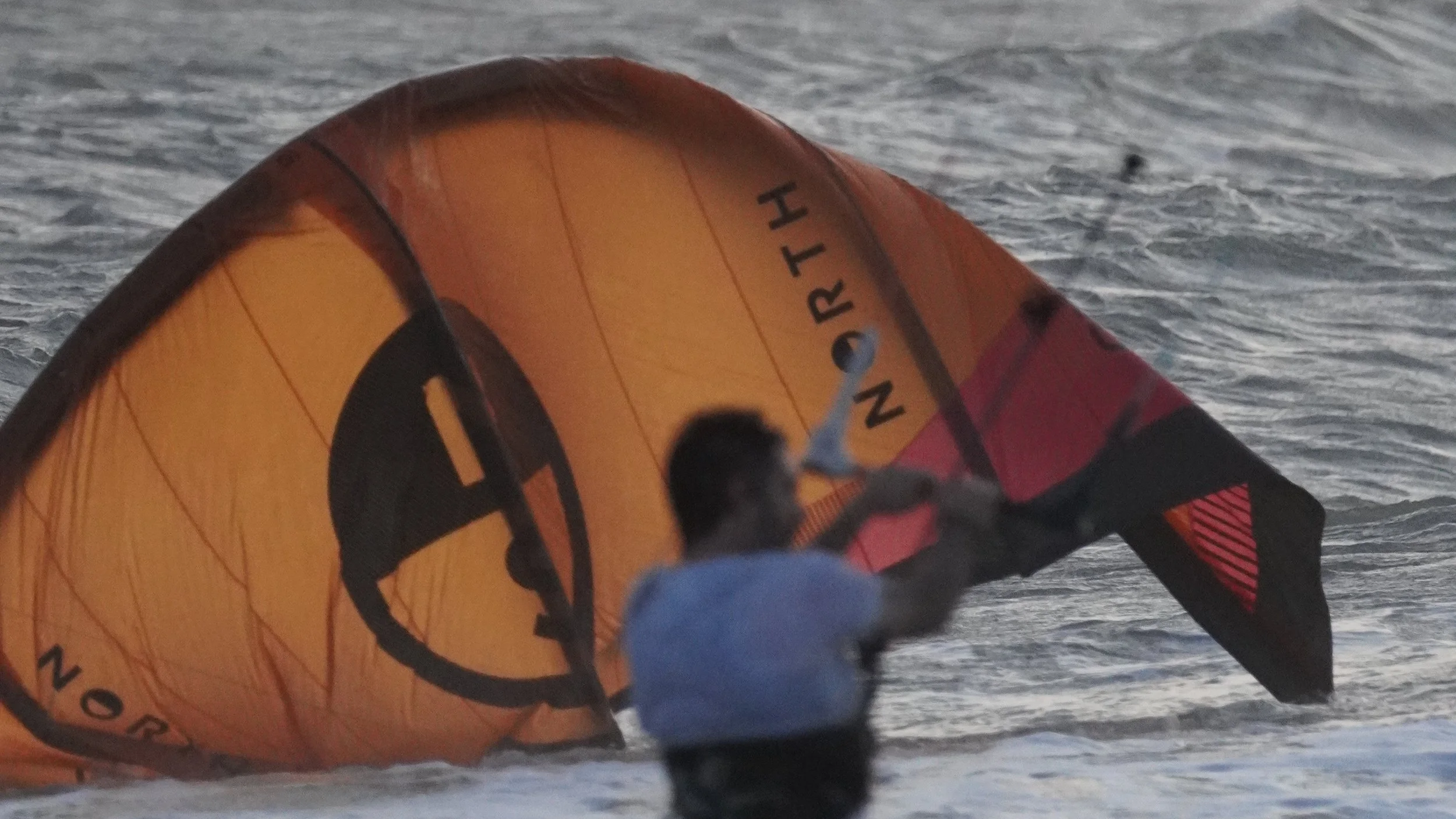
It is a scenario familiar to almost every kitesurfer who has pushed their limits. You try a transition, catch an edge, perform a spectacular faceplant, and surface to find your kite has done something deeply weird. Not just crossed lines. The actual fabric profile has rolled through its own bridles. The canopy is completely inside out, the struts are bent backward, and you are staring at the wrong side of the nylon.
I found this out firsthand in a 25-knot session while over-rotating a backroll to the right. Even on a stable wave kite designed to drift, crash it hard into the power zone during a downloop and let a wave catch the leading edge, and the water and wind will force it inside out instantly. I was bobbing around staring at a backwards flying plastic bag wondering how this became my afternoon.
A fully inverted kite is frustrating, expensive to ignore, and entirely fixable if you know the sequence. Understanding why the canopy flips, what to do in the first few seconds, and when to reach for the quick release is the difference between a ten-second recovery and a long swim home.
What actually happens when a kite turns inside out?
When your kite inverts, the canopy rolls completely through its own bridle lines, exposing the top of the fabric to the oncoming wind instead of the bottom. During normal flight, wind splits at the leading edge, moving faster over the curved top surface to create low pressure and generate lift. When the canopy rolls through the lines, that aerodynamic balance shatters instantly.
The wind now hits the top side of the fabric at a negative angle of attack. Instead of flying forward, the canopy behaves like an unstable sail, fluttering wildly and ignoring your steering inputs. A four-line kite can technically still fly inverted, but the struts have a much smaller diameter than the leading edge and buckle easily under reverse load. Flying an inverted kite back to the beach risks blowing seams and popping bladders. If you are in a dangerous wave impact zone and need to keep the kite in the air, depower the bar as much as possible to reduce stress on the fabric.
Why does your kite fall and flip?
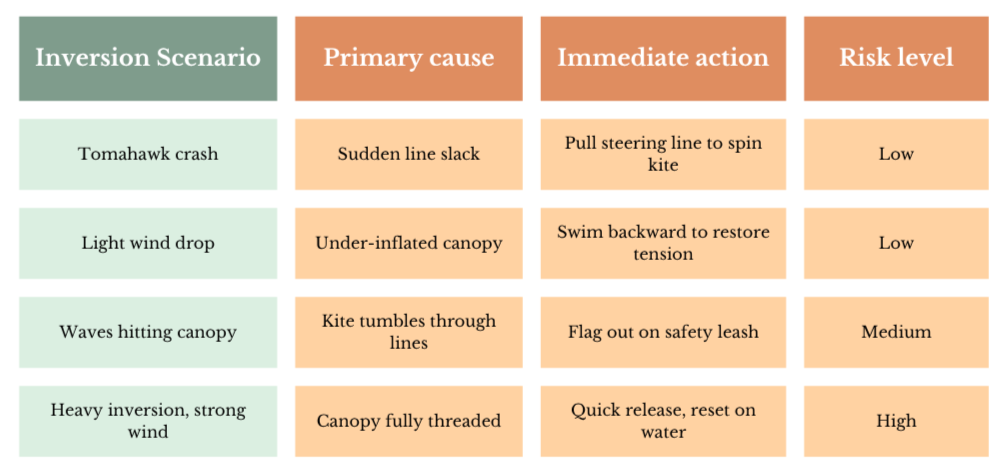
The root cause is always the same: sudden and complete loss of line tension right after a crash. When you go down, your momentum stops but the kite keeps moving forward. If it overflies the wind window, it frontstalls and tumbles out of the sky. The lines go completely slack, leaving the airframe at the mercy of the wind and water. Without tension, the wind can catch the trailing edge first, lifting the back of the kite up and pushing the canopy through the bridles.
Several specific scenarios trigger this:
Under-inflation: A soft leading edge buckles under aerodynamic load and the airframe has no structure to resist the roll.
Downwind drift: Continuing to move downwind after a crash slacks the lines faster than the kite can compensate.
Light wind lulls or wave swells: Outrunning your kite on a wave set gives the canopy time to tumble before you can edge back upwind.
High-aspect and lightweight kites are especially vulnerable to these dropouts. Dedicated drifting wave kites hold their shape better under slack lines, but as my backroll session proved, even those have a limit. For more on how gusty, inconsistent conditions set up these crashes, read what causes gusty wind in the first place.
What should you do the moment your kite inverts on the water?
The absolute worst thing you can do right now is grab the control bar and yank it. Pulling the bar loads the steering lines, chokes the kite, and prevents the wind from getting under the canopy to help it roll back. Let go of the bar completely, first.
If you’re still riding, try to go upwind as fast as possible to regain tension in the lines. But sadly this happens mostly after a good crash.
If the kite is still tumbling in the air, start swimming backward immediately. If you are wearing your board, put it on your feet, bend your knees, and pump your legs aggressively. This drags your body backward through the water and pulls the lines taut before the canopy finishes its roll.
If the kite has already splashed down on its back with the leading edge facing skyward, try the manual roll. First, grabbing the center lines and pulling them in firmly can sometimes shorten the front lines relative to the steering lines. This action forces the leading edge downward, allowing the wind to get behind the canopy and pop the kite back into its correct shape.
Second thing to try. Grab one of the outer steering lines at the floater end and pull it in hand over hand for roughly two meters. That localised tension forces the kite to pivot on its wingtip, catching the wind on the correct side of the canopy and popping the airframe back into shape. The moment you see the canopy reform, let go immediately to avoid a sudden relaunch into your face.
How does the quick release save your gear?
If the manual pull does not work, or if the wind is already powering up the inverted canopy uncontrollably, trust the safety system. Activate your chicken loop quick release.
Punching out disables the kite and flags it out on a single center line. With all steering line tension removed, the wind pushes the flagged canopy downwind and the roll typically self-corrects as the canopy settles flat. Once it looks normal and is lying quietly, pull yourself hand over hand up the safety line to recover the bar. Reset the chicken loop, reattach to your harness, feed the safety line back through the bar, and proceed with a standard water relaunch.
You will probably end up with crossed lines afterward. The kite will still fly well enough to get you back to the beach, which is a massive win compared to swimming home with a shredded canopy.
What about bar juggling for severe line tangles?
For advanced riders facing severely twisted lines that neither the manual pull nor the quick release fully resolves, there is bar juggling. Do this only in light wind and shallow flat water.
The process involves unhooking the chicken loop and physically passing the control bar through the front lines to untangle the twist. The critical rule is to maintain a firm grip on the center lines at all times. Holding the center lines prevents the kite from catching the wind and suddenly powering up while your safety systems are disconnected. If a steering line wraps around the bar end during the juggle, the kite can launch into an uncontrollable spiral. At that point you are no longer dealing with an inversion, you are dealing with something closer to the situation in survive the scary deathloop. If there is any doubt, fly the crossed lines back to the beach and sort it on land.
How do you stop the kite inverting in the first place?
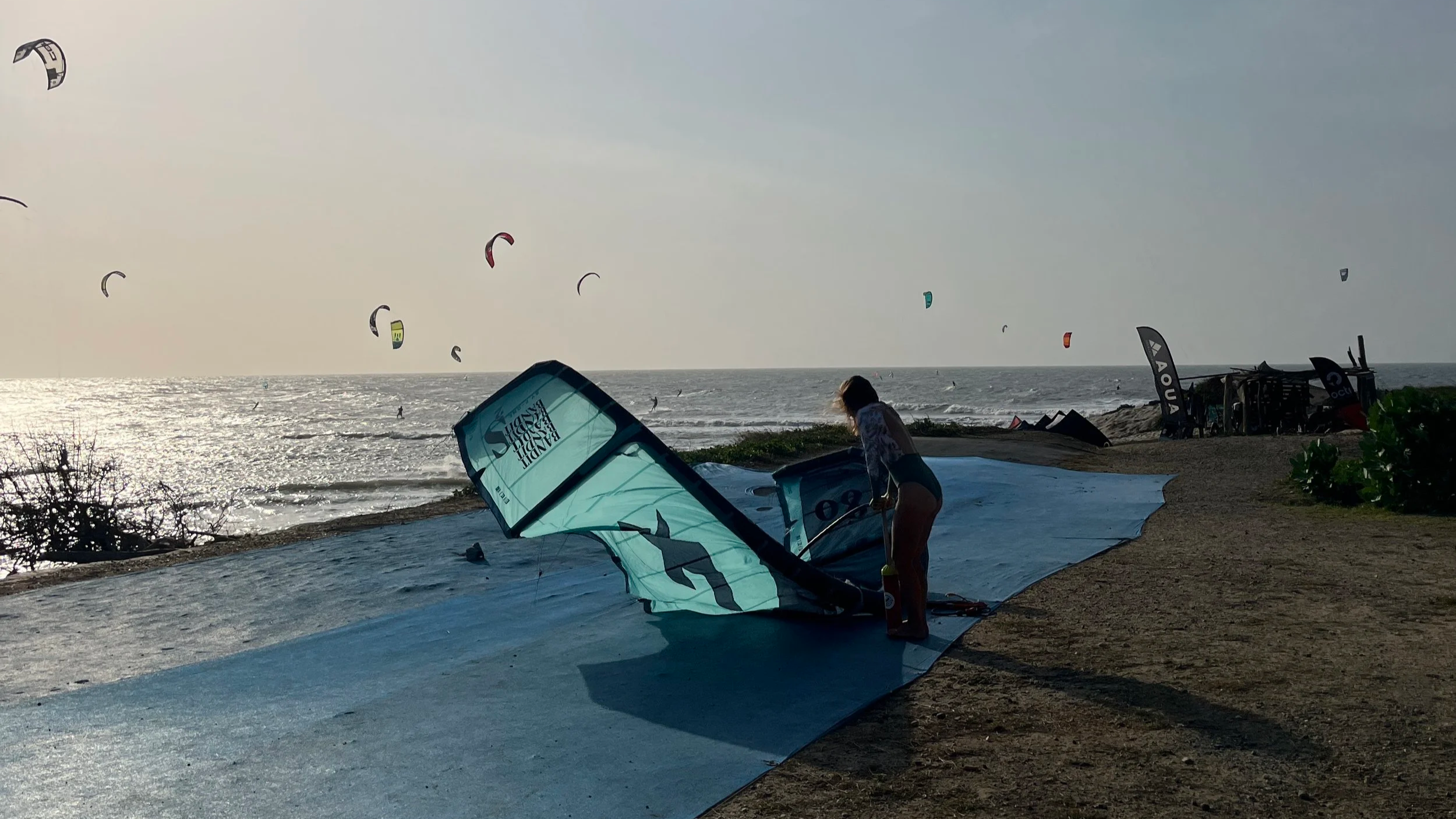
Prevention comes down almost entirely to two things: inflation pressure and reaction speed.
Pump your leading edge hard. Use a pressure gauge rather than guessing by hand feel, and give it the extra pumps to make the airframe rigid. A rock-hard leading edge resists buckling and makes it much harder for the canopy to pop through the bridles when lines go slack. Under-inflation is one of the most common gear mistakes that quietly wrecks your sessions. If you are not sure your setup habits are sound, read gear mistakes that kill your progress.
Close your strut clamps before launching. If the kite does invert, isolated struts keep bladder pressure separate and prevent twisting and explosive decompression.
React fast after a crash. The moment you feel yourself going down, edge hard upwind with the board to maintain line tension. If you are already in the water, swim backward before the lines have time to go completely slack. Speed of reaction matters more than any piece of gear. For a deeper look at active kite control during tricky moments, keep your kite in the sky covers the light-wind side of this well.
May line tension stay forever
An inverted kite is not the end of your session, it is just an aerodynamic puzzle. Keep the leading edge rigid, react instantly after a crash to restore tension, and know which recovery method to reach for when the canopy is already on its back. A kite is designed to fly forward, not backward, so do not try to force an inside-out wing to stay in the air longer than you have to.
Because swimming home while dragging a giant soggy nylon parachute is not the look anyone is going for.
xox Berito
Quick answers
-
An inverted kite has rolled completely through its own bridle lines so the top of the canopy faces the wind instead of the bottom. This produces a negative angle of attack and makes the kite unstable and unsteerable. It is caused by a sudden loss of line tension, usually right after a crash.
-
A four-line kite can technically stay in the air while inverted, but doing so puts severe stress on the struts and seams. Flying an inverted canopy back to the beach risks bladder blowouts. If you must keep it flying to escape a wave zone, depower fully and move as quickly as possible.
-
Let go of the bar completely. Do not pull. Swim backward to restore line tension, or pull one outer steering line hand over hand to pivot the kite on its wingtip and pop it back into shape. If neither works, activate the chicken loop quick release to flag the kite out and let the wind roll it back.
-
Yes. A soft leading edge has no structural resistance and buckles easily under aerodynamic load when lines go slack. Always pump to the manufacturer's recommended pressure and use a gauge rather than estimating by touch.
-
Bar juggling is an advanced water recovery technique where the rider unhooks the chicken loop and physically passes the control bar through the front lines to untangle a severe twist. It should only be attempted in light winds and flat, shallow water, with a firm grip maintained on the center lines throughout.