
Understand kite beach slang
“Kitesurfing runs on its own dictionary, covering wind, gear, flying technique, and riding style. Knots, sheeting, chicken loops, and pigtails are just the start. Learn the core terms below and the next pre session chat will finally make sense.”
You walk onto the beach, your heart is pumping, and you are fresh out of your beginner lessons. You stand next to some local riders, hoping to make friends and join the conversation. But the moment they open their mouths, you feel like you accidentally stepped into a secret foreign country. They are talking about nuking winds, heavy gusts, sheeting out, sending massive loops, and getting tea bagged. You smile, nod politely, and desperately hope they do not ask you for your opinion on the apparent wind angle.
We have all been there. Kitesurfing is an incredibly technical sport, and it comes with its very own ridiculous dictionary. Understanding the local beach jargon is completely essential if you want to integrate into the community without feeling totally lost. It is not just about sounding cool, although that is definitely a nice bonus. Knowing the correct terms actually keeps you safe, helps you buy the right gear, and lets you ask the right questions when you need help. We are going to decode the most important kitesurfing terminology so you can finally join the pre session chat with complete confidence. Let us break down the beach slang into digestible pieces so you can focus on riding instead of scratching your head in confusion.
What do all those wind terms actually mean?
The wind is our absolute obsession, so naturally, we have a million words to describe exactly what the invisible air is doing. The most basic term you need to know is knots. We do not measure wind in miles or kilometers per hour. We use knots, which is a classic maritime measurement. When someone says it is blowing twenty knots, that is the average speed of the wind. But the wind is rarely perfectly stable. This brings us to gusts and lulls. A gust is a sudden, aggressive spike in wind speed that tries to rip the bar out of your hands. A lull is a sudden drop where the wind briefly dies down and your kite threatens to fall out of the sky. If a spot is highly unpredictable, riders will complain that the wind is punchy or gusty.
You also need to know the basic direction terms. Onshore wind blows straight from the ocean onto the beach, making it hard to get out and very dangerous because a mistake sends you flying into the sand. Offshore wind blows from the beach out to sea, which means if you crash, you are floating away forever towards another continent. Side shore is the golden ticket, blowing safely parallel to the beach. You can check websites like Windguru to see the exact forecast and understand these directions before you arrive. For a deeper understanding of chaotic air, read my thoughts on what is it about gusty winds to better handle unpredictable sessions.
What are the parts of a kitesurfing kite called?
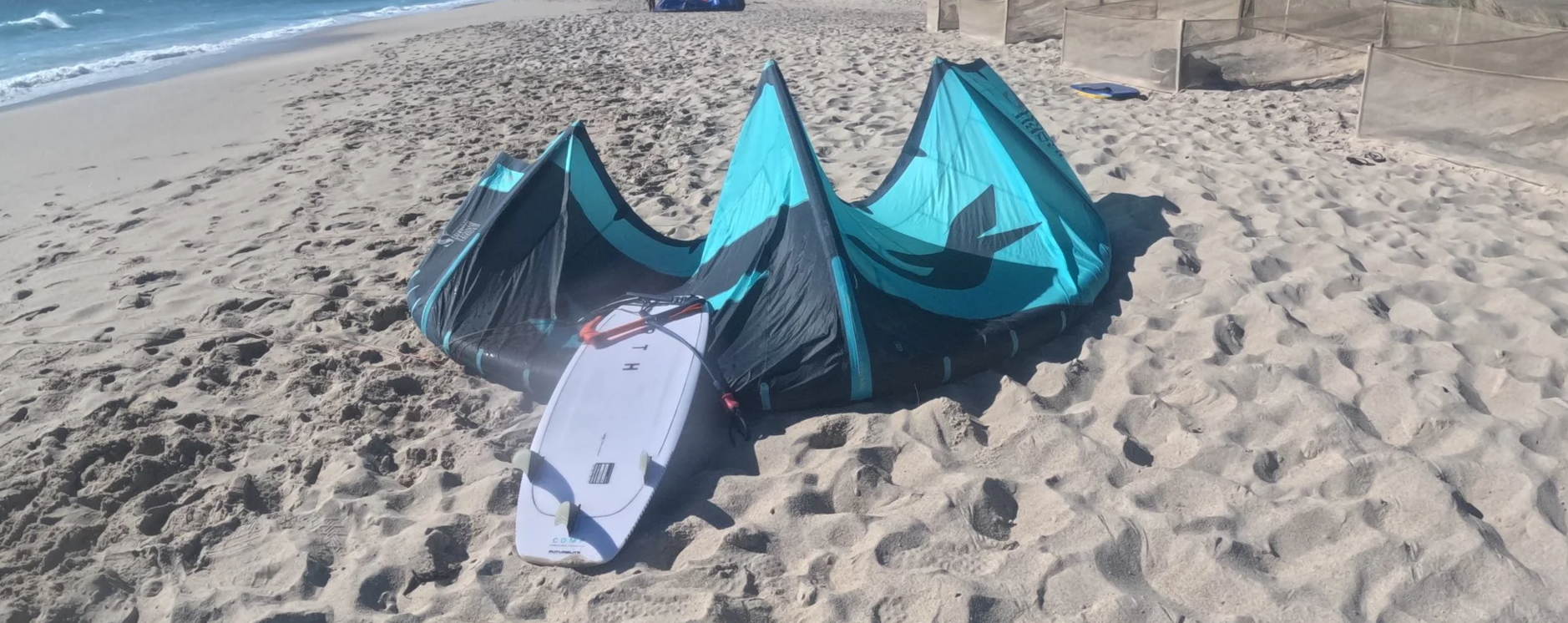
Now let us talk about the extremely expensive toys we play with. Your kite is not just a piece of fabric floating in the air. The main body of the kite is called the canopy. The inflatable tubes that give the kite its rigid shape are the leading edge, which is the thick front tube, and the struts, which are the smaller tubes crossing the canopy. When we talk about the control system, we refer to the bar and lines. The bar is your steering wheel. The chicken loop is the thick plastic ring that connects the control bar directly to your harness hook. Slightly above the bar, you will find the trim strap, which you use to adjust the overall baseline power of the kite. Another word you will hear constantly is pigtails. These are the small, thick pieces of line at the ends of your kite where you attach your flying lines. A common mistake beginners make is attaching the wrong lines to the wrong pigtails, which results in a kite that will not fly at all.
Here are some gear terms you must know:
Canopy: The main fabric material
Struts: The inflatable tubes keeping shape
Pigtails: The attachment points for lines
Bar: The steering wheel you hold
To make things even more complicated, foil kites are becoming popular, and they skip the inflatable structure entirely. A foil kite has no leading edge and no struts, nothing to pump up at all. It is built from layered fabric cells that hold their shape purely through air pressure, which is exactly why it looks like your paragliding cousin borrowed your kite gear. The name comes from foiling, since foil kites are the standard choice for hydrofoil boards, but you will also spot them on the water during light wind big air sessions. Why the hype? A foil kite generates serious lift for its size, holds you in the air longer, and weighs almost nothing compared to an inflatable. The catch is that if it drops in the water, relaunching turns into a soggy wrestling match. But on a day with barely enough wind to ruffle your hair, a foil kite will still get you flying, jumping, and pulling tricks that an inflatable kite would refuse to attempt.
Every kite bar ships with a set of lines, but not all lines are created equal. They differ in material, stretch, and breaking strength, and you will hear riders all over the beach swearing by The Line Smith. They make some of the strongest, stiffest aftermarket lines on the market, built with premium Dyneema and tested to a breaking strength that leaves stock lines embarrassed. That is exactly why their lines show up on the bars of some of the biggest names in big air. You do not need aftermarket lines to learn the sport, but once you start noticing your lines stretching or your kite responding a beat too slowly, you will understand the obsession.
Aluula, what the hell is that? It is a fabric, not a kite brand. If you spot a kite with a distinctive gold or yellow tint on the leading edge and struts, there is a good chance it is built from Aluula instead of the usual Dacron. It is the material everyone is hyped about right now, and for good reason. Aluula can shave up to half the weight off a kite while making it stiffer and more tear resistant at the same time, which translates into faster steering and a kite that survives more abuse. The catch is the price tag, since Aluula kites cost noticeably more than their Dacron counterparts. You do not need it to learn or even to progress fast. But if your wallet can handle it, it is a genuine upgrade, not just hype.
What is the wind window and how do you use it?
When your kite is in the air, you are navigating the wind window. The wind window is the invisible three dimensional dome in front of you where the kite can actually fly and generate pull. The absolute top of this dome, sitting directly above your head, is called the zenith or twelve o clock. When the kite is at the zenith, it rests in a neutral position with very little forward pull. The edge of the window is the outer rim of this dome, where the kite produces the least amount of power. The power zone is the area deep in the middle of the window, straight downwind from you. If you fly your kite aggressively through the power zone, it generates a massive, explosive pull that will launch you forward. This brings us to sheeting. Sheeting in means pulling the control bar close to your chest, which catches more wind and generates immediate power. Sheeting out means pushing the bar away from you, which spills the wind and depowers the kite instantly. You can read more about how lift and drag work in my detailed post on how does a kite work to fully grasp the aerodynamics of your steering movements.
How do you talk about riding upwind and downwind?
Once you have the kite flying beautifully, you need to actually ride the board on the water. The holy grail for every single beginner is learning to ride upwind. Riding upwind means traveling at a sharp angle against the wind direction, allowing you to return to the exact same spot on the beach where you started. If you cannot do this, you are riding downwind, which means you are being pulled along with the wind and will eventually have to do the dreaded walk of shame back up the beach carrying all your wet gear. To ride upwind, you must hold an edge. Edging means pushing the rail, which is the side of your board, firmly into the water to resist the pull of the kite. When you want to change direction, you will perform a transition. A transition is simply turning around to ride the other way without sinking. For advanced riders, a tack is a transition where you turn the nose of the board through the wind, while a jibe is turning the nose of the board away from the wind.
Look out for these riding terms:
Upwind: Riding against the wind direction
Downwind: Riding with the wind direction
Edging: Pushing the rail into water
Transition: Changing your riding direction
Once you have upwind dialed in, someone will eventually invite you on a downwinder. This means you start at one spot on the coast and ride all the way down to a different end point, letting the wind carry you along the way. After spending weeks fighting to go upwind, this might sound backward. But a downwinder is genuinely one of the best sessions you can have. You do not have to fight to hold your ground, so you can experiment, try new tricks, and just let the drift do the work.
What do wipeout, tea bagged, and deathloop actually mean?
Kitesurfing is an extreme sport, and things will inevitably go wrong, generating some very funny vocabulary to describe our failures. The most common term is a wipeout, which is simply a spectacular crash where you swallow half the ocean. If you mess up your kite control and get repeatedly lifted out of the water and dropped back down violently, you are being tea bagged. It is exhausting for you but highly hilarious for everyone watching from the beach. Another scary term is a deathloop. This happens when a steering line gets caught around the end of the bar, causing the kite to spin aggressively and endlessly in the power zone while dragging you. I have already broken down exactly why this happens and how to survive one in survive the scary deathloop. On the positive side, when you jump high into the air, we call it boosting or sending it. Sending it implies fully committing to a jump or a trick with absolute confidence, even if you are not entirely sure how it will end. Knowing these terms helps you explain exactly what happened during your session when you return to the beach for a cold drink with your friends.
What's the difference between big air, freestyle, freeride, and waveriding?
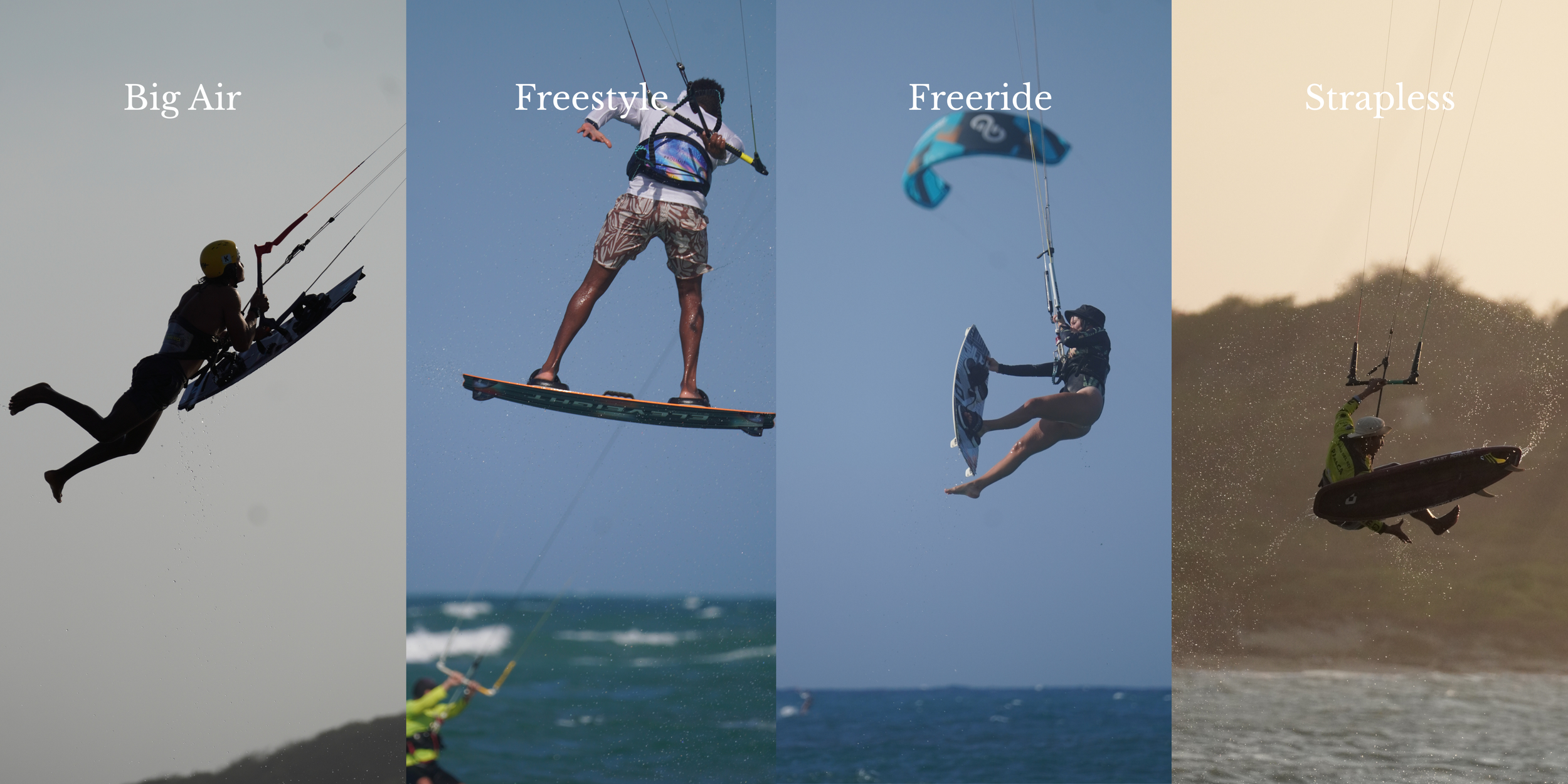
Big air is exactly what it sounds like. You go big, in the air. Riders boost massive jumps and loops, sometimes launching twenty meters or higher and stacking tricks mid flight before they even think about landing. If you ever see someone disappear above the horizon line and come back down still spinning, that is big air. The discipline has its own world stage too: the Red Bull King of the Air in Cape Town is the biggest event in the sport, and watching it is the fastest way to understand exactly how high "big" can go.
Freestyle used to be the biggest hype in the sport, and while big air has stolen some of the spotlight, freestyle is still very much alive. If you have ever seen riders with boots strapped to their boards, just like wakeboarders, those are freestylers. They throw technical, often unhooked tricks low to the water. Unhooking means disconnecting your chicken loop from your harness mid trick, which means all of the kite's pull lands directly in your hands instead of your hips. It looks brutal on the arms because it is.
Freeride is the category that makes sense the moment you hear it. It just means riding freely, with no fixed agenda. That might be cruising up and down the coast, throwing the occasional jump, or mixing in a few tricks when the mood strikes. It is the broadest category in the sport, and honestly, most sessions you will ever have fall under it.
Waveriding does exactly what it says. Riders combine kitesurfing with actual surfing, using the kite for power while carving and riding waves the way a regular surfer would. It usually happens on a directional board, and it turns your kite into a tool for catching waves rather than the main event.
Strapless freestyle, and no, this has nothing to do with going unhooked in a strapless bra. Strapless refers to the board, not your outfit. On a twin tip, your feet sit locked into straps. On a directional board, or a surfboard built for kiting, you get to choose whether you ride with straps or without. Riding strapless is significantly harder, because nothing is gluing your feet to the board, every landing and every transition relies purely on balance and foot pressure. Strapless freestyle is simply landing tricks on a strapless, directional setup, and it is one of the fastest growing categories in the sport right now.
Before you join the chat
Learning to kitesurf is hard enough without feeling like you need a translator just to hang out on the beach. By grasping these basic terms, you will not only sound like you actually know what you are doing, but you will also understand vital safety advice and gear recommendations from experienced riders. It takes a little bit of time to memorise the difference between sheeting in and sheeting out, or remembering what a chicken loop does, but soon it will become your second language. The next time you rock up to your local spot, you can proudly ask about the base knots and gust spreads without feeling like an absolute imposter. Grab your gear, walk down to the water confidently, and enjoy the session.
Just remember that shouting the right words will not actually save you from a spectacular wipeout.
xox Berito
Quick answers
-
Sheeting out means pushing the control bar away from your body to depower the kite almost instantly.
-
Onshore wind blows from the water onto the beach, offshore blows from the beach out to sea, and side shore blows safely parallel to the beach.
-
The chicken loop is the plastic ring on your control bar that hooks onto your harness and houses your quick release.
-
Freestyle is technical, often unhooked tricks close to the water, while freeride is just riding with no fixed agenda.
-
It means your kite repeatedly lifts you out of the water and drops you, exhausting for you, hilarious for everyone watching.