
Why surfers hate kitesurfers
“Surfers resent kitesurfers because we arrive at speed, we are attached to twenty meters of invisible line, and a paddling surfer has no way to get out of our path. Most of the time nature keeps the two groups apart, because surfers want glass and we want wind. Learn to surf anyway, because it will do more for your wave riding than any new board will.”
We have all been there. You are blasting across the water at thirty knots, half your attention on the chop and half on your kite, and a surfer is sitting silently at chest height in your peripheral vision. The honest version is that we often do not see surfers until the last second. We move fast, our kites demand constant attention in the sky, and from the water you look like a projectile with no obvious plan.
That split second where a kiter cuts past a few meters away is genuinely frightening for someone whose only engine is their arms. Fear turns into irritation quickly, and that is where the whole love hate relationship comes from. It is worth looking past the near miss though, because the dynamic between people who paddle and people who harness the wind is full of shared gear, opposite conditions, and one big opportunity to become a better waterman.
Why do surfers get annoyed at kitesurfers?
Because a surfer sitting in the water cannot see you coming, cannot move out of the way, and cannot judge how close your lines are going to pass. From their position, every fast pass is a gamble they did not agree to.
Three things make it worse than it looks from behind the bar:
Speed difference: you close a fifty meter gap in a few seconds, which is roughly the time a surfer needs to turn a board around.
Invisible hazard: your lines sweep a wide arc that nobody in the water can actually see, and a duck diving surfer has no idea where they are.
Different rules: surfing priority is built around who is closest to the peak, kitesurfing right of way is built around who is on starboard, and neither group knows the other set.
None of that is hypothetical. The single fastest way to ruin a beach for everyone is to buzz someone who is lying flat in the water with no way to escape. Widening your turns and leaving a generous buffer costs you nothing and prevents most of the shouting that happens back on the sand.
Why do surfers and kitesurfers end up in the same spot?
Usually because a local authority put them there. On a lot of coastlines every board sport gets pushed into one designated water sports zone so the swimming area stays clear, which means surfers, kitesurfers, wing foilers, windsurfers and occasionally a jet ski all share the same rectangle of water.
That is a zoning decision, not a personality clash. Kitesurfers need open space for twenty two meter lines and long carving turns. Surfers sit in tight clusters exactly where the wave breaks, because that is the only place the wave works. Put both in a small box and the friction is structural.
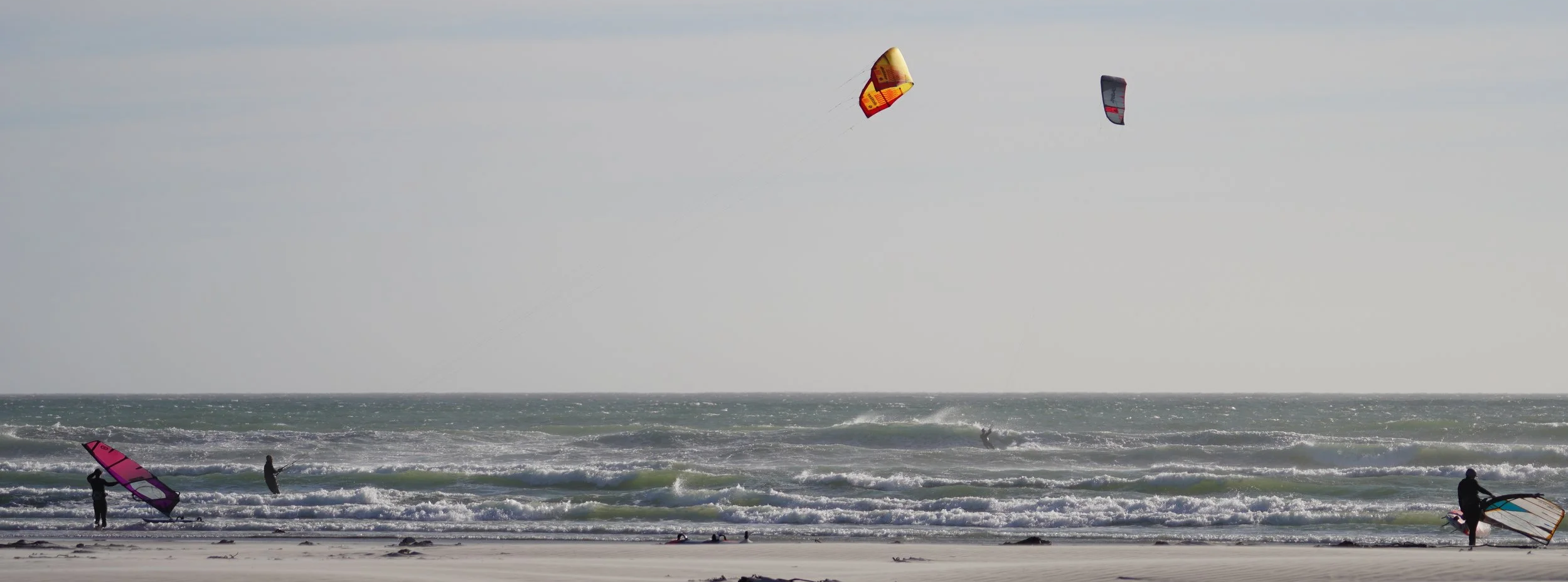
Do surfers and kitesurfers even want the same conditions?
No, and that is the thing that saves us. Surfers want clean, glassy faces with no wind on the water. We need the wind to crank. Those two conditions almost never show up at the same time.
Glass: surfers score at dawn and dusk when the atmosphere is dead and the face is smooth.
Wind chop: we thrive when the breeze is building, the surface is textured and the windswell starts rolling in.
Different beaches: surfers head for sheltered point breaks, we hunt exposed stretches where nothing blocks the flow.
The handover happens most days around midday. Surfers pack up the moment the onshore sea breeze arrives, which is the exact moment we start pumping. If your spot has a real overlap problem, it is usually a short window rather than a whole day, and knowing when that window is before you drive to the beach saves a lot of tension.
What gear works for both surfing and kitesurfing?
More than you would expect. Anything that protects you from the elements rather than powering you across them tends to be interchangeable.
Wetsuits and thermal tops: a good suit from a surf brand and a good suit from a kite brand do the same job.
Surf earplugs: cold wind and salt water cause surfer's ear in both sports, and neither group takes it seriously enough.
Zinc and water resistant sunscreen: long hours on open water, same problem.
Change buckets, wax and dry bags: identical needs, identical solutions.
The one piece of kit that does not cross over is the board, which deserves its own answer.
Can you kitesurf on a normal surfboard?
You can, briefly, and then you will hear a noise you do not want to hear. A standard surfboard is built as light as possible for paddling and arm driven maneuvering. A kite directional is built with reinforced stringers, heavier glass and denser foam, because kiting loads a board in ways paddling never does.
The difference is not the wave, it is the landing. Kiting delivers relentless heel pressure and constant chop chatter, plus the occasional flat landing that a surfboard deck was never designed to absorb. Pressure dents first, then a cracked deck, then delamination.
If you want to test the idea anyway, use an old board you have already made peace with losing, and read gear mistakes that kill your progress first, because riding equipment outside its design envelope is on that list for a reason. For general equipment standards, the IKO is a reasonable place to start.
What can surfers and kitesurfers learn from each other?
Quite a lot, and the split is clean. Surfers understand water. We understand air.
Surfers can teach you wave anatomy: how a sandbar bends a swell, where a wave will start to peel, where the shoulder is, how to position instead of chase.
Kiters can teach them weather: thermal cycles, gust patterns, pressure systems, why the afternoon onshore breeze that ruins their session is completely predictable.
Both can teach each other rescue: losing a board, getting caught in a rip, and getting someone back to the beach are shared problems with shared solutions.
We also travel the same way, chase the same forecasts and end up in the same beach bars from Portugal to South Africa. Standing there glaring across the sand is a waste of a perfectly good information source.
Does learning to surf make you a better kitesurfer?
Yes, and it is the most underrated upgrade available to a kite wave rider. Without a bar in your hands and a harness to lean against, you have to generate speed from body compression, rail pressure and timing alone. That is exactly the skill set that makes kite wave riding look good.
Prone surfing on windless days forces you to:
Read the wave face without kite power to pull you through the flat sections.
Load your knees and hips properly to drive a bottom turn into the pocket.
Build shoulder stamina and handle wipeouts calmly, which is the same composure you need when gear fails.
The classic kiter mistake is using the kite as a crutch, standing stiff and letting the canopy drag you along the face. Paddle surfing removes the crutch. When the wind comes back your turns are sharper, your stance is lower, and you are riding the wave rather than being towed across it. It is also decent off season training, in the same category as the core work that actually transfers.
How do you share a break without starting a war?
Assume you are invisible to everyone in the water and ride accordingly. That single assumption fixes most of it.
Give surfers a wide berth, wider than feels necessary, because your lines extend further than your board.
Respect the zoning even when it is badly drawn, because arguing about it in the water helps nobody.
Save your fast carves for open water down the beach, not the peak where people are sitting.
Launch and land away from paddlers, since that is when your kite is least predictable.
It is also worth remembering what the stakes are. A collision between a kite and a paddling surfer is not a scuffed rail, it is a head injury, and the injury list is grim enough without adding someone else to it. Gear etiquette runs the same way on the beach, which I have been blunt about in your kite is not a rental.
Before you paddle out
The tension between the two groups is mostly a spacing problem dressed up as a tribal one. Give people room, understand why a surfer flinches when you pass, and use the windless days to learn what they already know. When the wind returns you will ride better for it.
Just do not tell a tired surfer that you catch more waves because you have a kite. That is a fast way to find your tires mysteriously flat.
xox Berito
Quick answers
-
Because kitesurfers move fast, carry invisible lines, and a paddling surfer has no way to get clear. It is a safety reaction before it is a rivalry.
-
No. Surfers want glassy water with no wind, kitesurfers need wind. The two rarely peak at the same moment, which keeps most beaches workable.
-
Technically yes, but not for long. Surfboards are built light for paddling and will dent, crack or delaminate under kite loads and hard landings.
-
Wetsuits, thermal tops, earplugs, sunscreen, wax and dry bags all work for both. Boards do not.
-
Yes. Prone surfing teaches wave reading and rail control without kite power, which transfers straight back to your directional board.
-
Treat the surfer as having priority every time. Rules differ between the sports, and you are the one who can actually change course.